0
0

Commercial Curtain Installation Singapore: What Matters
Commercial curtain installation Singapore: fabric, tracks, light control, safety and fitting details for a practical, durable workplace that works daily.
READ MORE →

A bedroom facing the morning sun, a living room with strong afternoon glare, or a nursery where naps matter can make window treatment choices feel far more urgent. Blackout curtains Singapore homeowners choose are not simply decorative fabric panels. When specified and installed properly, they provide meaningful light control, greater privacy and a calmer, more comfortable room.

The key word is properly. A thick-looking curtain alone may dim a room, but the fabric, lining, track position, curtain fullness and gaps around the window all affect how much light enters. For a genuinely useful result, it helps to choose the system around the room rather than selecting fabric from a sample book alone.
Blackout curtains are made with fabric or lining designed to block light from passing through the curtain itself. They are especially useful in bedrooms, nurseries, home cinemas, shift workers’ rooms and spaces exposed to direct sun or neighbouring blocks.
They also improve privacy at night. With lights on indoors, a sheer curtain does little to prevent visibility from outside. A blackout curtain creates a more substantial visual barrier when closed, which can be reassuring in HDB flats and condominiums with nearby units.
They can reduce glare on televisions and screens, and may make a sun-facing room feel more comfortable by limiting direct sunlight. However, curtains are not a substitute for insulated glazing or air-conditioning. Their main strength is controlling the light entering through the window, with a secondary benefit in reducing the feeling of solar heat.
When choosing blackout curtains Singapore homeowners should understand that even a good blackout fabric may not create complete darkness on its own. Light can still enter from the top, sides and bottom of the curtain, particularly in bedrooms after sunrise. Careful measurement, suitable curtain width and proper installation can help minimise these light gaps.
A made-to-measure installation addresses this more effectively than ready-made curtains. The track can be positioned higher and wider than the window opening so the curtains overlap the frame when drawn. Where suitable, the curtains can return towards the wall at each side to reduce light leakage. The chosen header style and fabric fullness also affect how neatly the curtain closes.
For customers who are sensitive to light, it is useful to distinguish between blackout performance and a true near-dark room. A standard blackout curtain on a conventional track provides strong darkness for most households. A room requiring the highest possible control may need careful track placement, adequate overlap, a pelmet or recess solution, and attention to other light sources such as door gaps and indicator lights.
Blackout-coated fabrics usually have a backing that prevents light transmission. They are practical, available in many colours and textures, and often provide a clean, contemporary finish. Their performance varies, so viewing the fabric against a light source is worthwhile during selection.
A lined curtain uses a decorative face fabric with blackout lining behind it. This offers more freedom in texture and appearance, including linen-look, woven and patterned fabrics, while the lining supplies the light-blocking function. It can be a good option for homeowners who want the softness of a premium curtain fabric without compromising bedroom practicality.
The trade-off is weight. Lined blackout curtains can be heavier, which makes a correctly specified track and professional installation more important. In wider condominium windows or landed home living areas, motorisation may also make daily use more convenient.
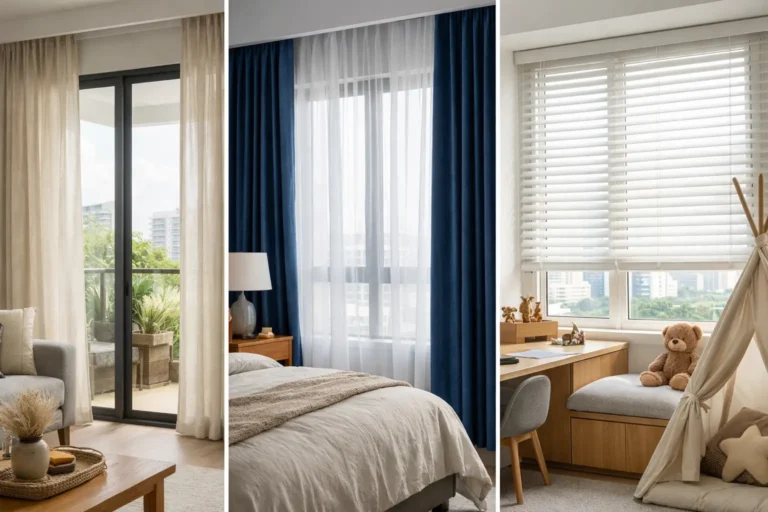
Bedrooms are the clearest choice, especially where occupants sleep early, wake later than the sun, work shifts or have young children. A blackout curtain paired with a sheer day curtain is a popular arrangement. The sheer softens daylight and provides daytime privacy, while the blackout layer is closed at night or whenever darkness is needed.
In living rooms, the decision depends on orientation and lifestyle. A west-facing unit may experience uncomfortable late-afternoon sun, while a room used for film viewing may need glare control. Blackout curtains work well, but some homeowners may prefer dim-out curtains instead. Dim-out fabrics reduce strong light without making the room as dark or visually heavy.
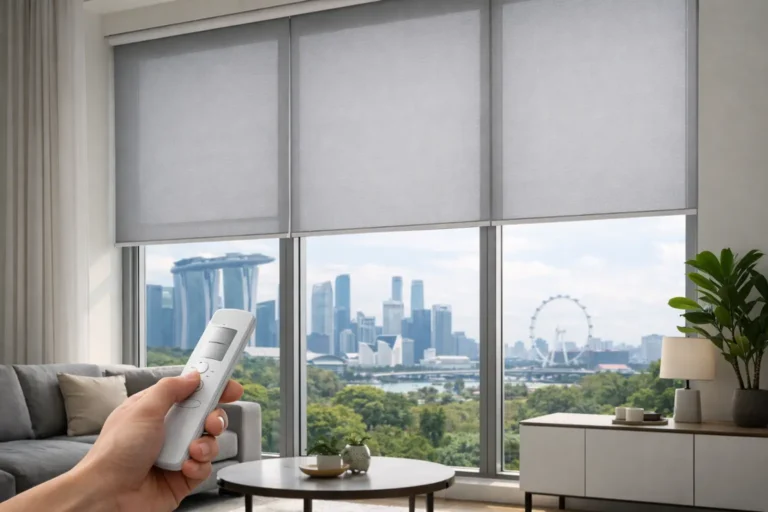
For a study, a roller blind with blackout fabric can be a tidy alternative, particularly when space around the window is limited. Curtains usually create a warmer, softer look and can help cover a wider wall of glazing. Blinds offer a more compact profile. The right choice depends on the desired appearance, window layout and how the room is used.
In a BTO or HDB bedroom, a simple blackout curtain on a ceiling-mounted track is often the most practical choice. Mounting close to the ceiling can make the room appear taller while allowing better coverage around the window. A neutral fabric keeps the room flexible if furniture or wall colours change later. A darker bedroom can also create a more comfortable sleep environment by reducing unwanted external light at night and in the early morning.
For blackout curtains Singapore condominium owners often need to consider larger windows or sliding balcony doors. Ripple-fold or S-fold blackout curtains can create a smooth, modern appearance when open and closed, while providing practical coverage when drawn. The curtains should extend across a broad section of glass, with sufficient stack-back space at the sides so the open curtains do not obstruct too much of the view.
Landed properties may have taller windows, bay windows or double-volume spaces. These projects need more detailed measurement and consideration of access for future cleaning and maintenance. Heavier or taller curtains may be better with motorised tracks, particularly where reaching the curtains daily would be inconvenient.
Manual curtains remain a sensible and cost-effective option for many bedrooms. A quality track, correct fabric weight and careful installation should allow them to glide smoothly. For regularly used windows within easy reach, motorisation is not essential.
Motorised blackout curtains Singapore homeowners choose can be particularly useful for large spans, high windows, elderly family members, young children or smart-home routines. Opening the curtains in the morning and closing them at night can be done by remote control, wall switch or compatible automation, depending on the system selected.
Motorisation should be planned before installation, especially if a concealed power point is preferred. Battery-operated options can suit some situations, but they need charging or battery management. During a consultation, it is sensible to discuss power access, curtain weight, track length and whether one or two curtain layers will be motorised.
Accurate measurement is one of the biggest differences between a curtain that looks acceptable and one that performs well. The installer needs to assess the window width and height, ceiling condition, pelmet or false-ceiling details, air-conditioning units, nearby cabinetry, balcony doors and the space required when curtains are open.
Fabric is then calculated with enough fullness to prevent a flat, stretched appearance. Too little fabric can make the curtain look sparse and may allow more light through the folds. Too much can add unnecessary bulk and cost. There is no single ratio that suits every fabric and heading style.
With more than 40 years of experience, Sincere Interior Service approaches this as a complete custom process: consultation, site measurement, fabric selection, Singapore-based in-house sewing and production, followed by professional installation. Direct factory pricing is helpful, but the more lasting value is accurate fit and workmanship that supports daily use. A 12-month warranty and post-installation service also give homeowners a clear point of contact after the work is completed.
Vacuum curtains gently with a soft brush attachment from time to time, paying attention to the top folds where dust settles. For stains, follow the care guidance for the specific fabric and lining rather than using harsh cleaning products. Some curtains may be suitable for professional cleaning, while others should only be spot-cleaned.
Avoid pulling fabric panels rather than using the leading edge or wand, as this can strain the header over time. If curtains begin to drag, catch or fail to close evenly, arrange an inspection early. A minor track or hook adjustment is easier to address before it causes fabric damage.
Blackout curtains should make your home work better, not simply make it darker. Bring along your floor plan, photographs of the windows and a sense of when the sun affects each room. That gives an experienced curtain specialist the information needed to recommend a solution that feels right from the first night you close it.
Not sure which curtain style, fabric or system suits your home? Speak with our team for personalised recommendations for your space.
GET IN TOUCH →