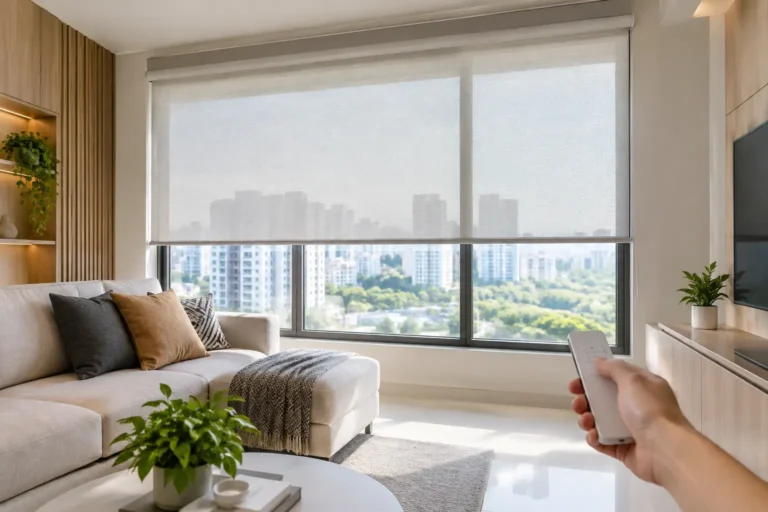
HDB Curtain Ideas Singapore: Curtains & Blinds for Privacy, Light Control & Small Spaces
Published 18 Nov 2026
•
13 min read
The most useful HDB curtain ideas start with how each window is used, not simply which fabric colour matches the sofa. In a Singapore flat, the same window treatment may need to soften afternoon glare, provide privacy from a nearby block and keep a compact room feeling open.
For many HDB and BTO homes, day and night curtains offer the greatest flexibility. Sheer curtains filter daylight and provide daytime screening, while dim-out or blackout curtains add privacy after dark. However, curtains are not always the right answer. Roller, Korean or combi, honeycomb and Venetian blinds can work better where space is tight or furniture sits close to the window.
The right choice depends on sunlight direction, privacy, window size, furniture layout and how much wall space is available when the curtains are open. Accurate measurement matters because the fabric, track and stack-back all affect how much of the window remains usable.
Start with light, privacy and available space
Before choosing curtains or blinds, look at the window at different times of day. A west-facing living room may become uncomfortable in the late afternoon, while a bedroom facing another block or common corridor may need stronger privacy.
Next, consider what you want from the window treatment when it is open and closed. Some homeowners want an unobstructed daytime view but full privacy after sunset. Others need stronger room darkening for shift work, children’s naps or movie nights.
Space matters too. A full-height curtain needs somewhere to stack when opened. If a wardrobe, feature wall or built-in cabinet sits beside the window, too much curtain fabric can cover part of the glass even when fully drawn back.
This is one reason a made-to-measure solution is especially useful in HDB and BTO flats. Air-conditioning trunking, window handles, beams, pelmets and carpentry can all affect the final arrangement.
HDB Curtain Ideas for Living Rooms
The living room usually needs the most flexible window treatment because it serves several purposes throughout the day. You may want natural light in the morning, reduced television glare in the afternoon and privacy after dark.
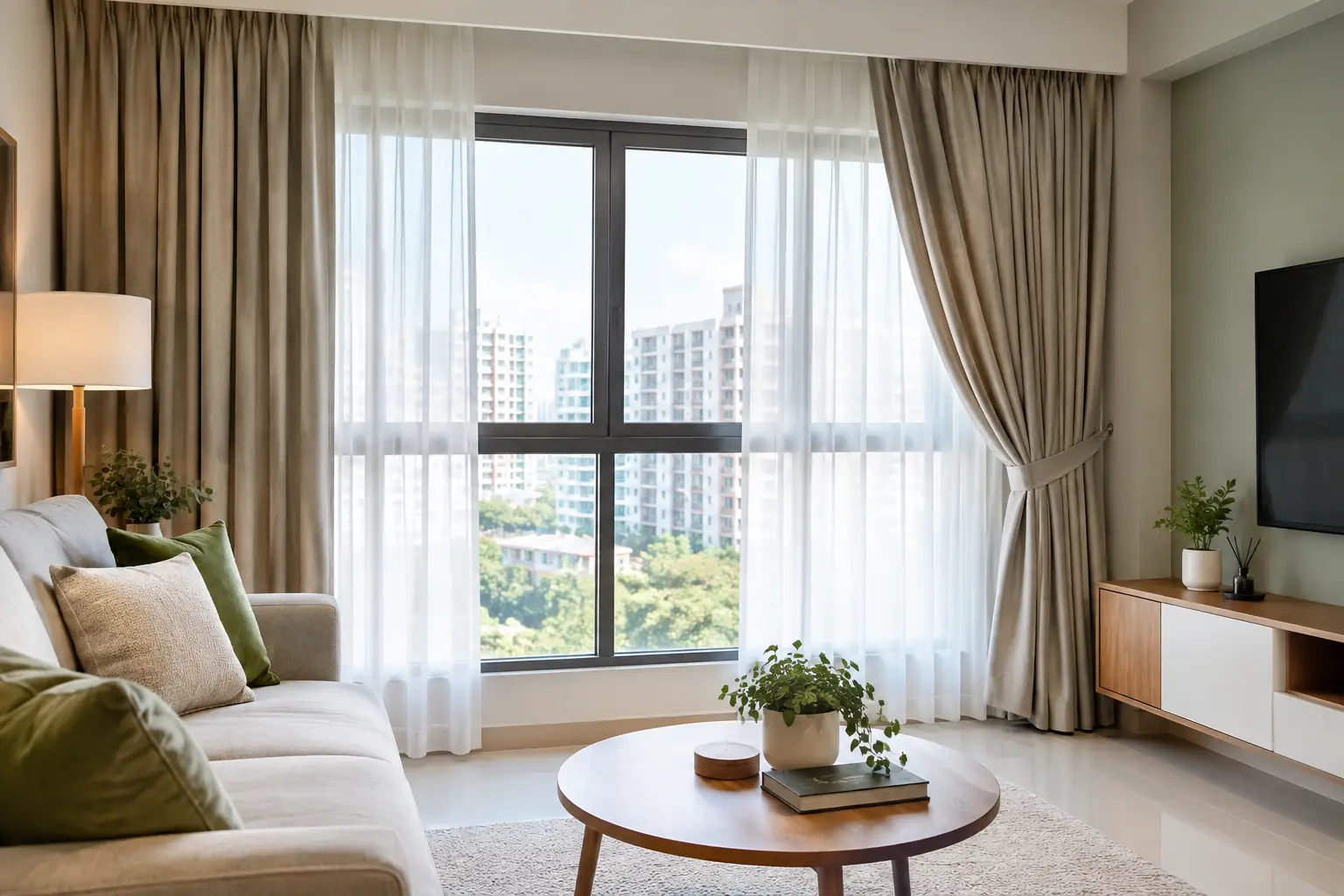
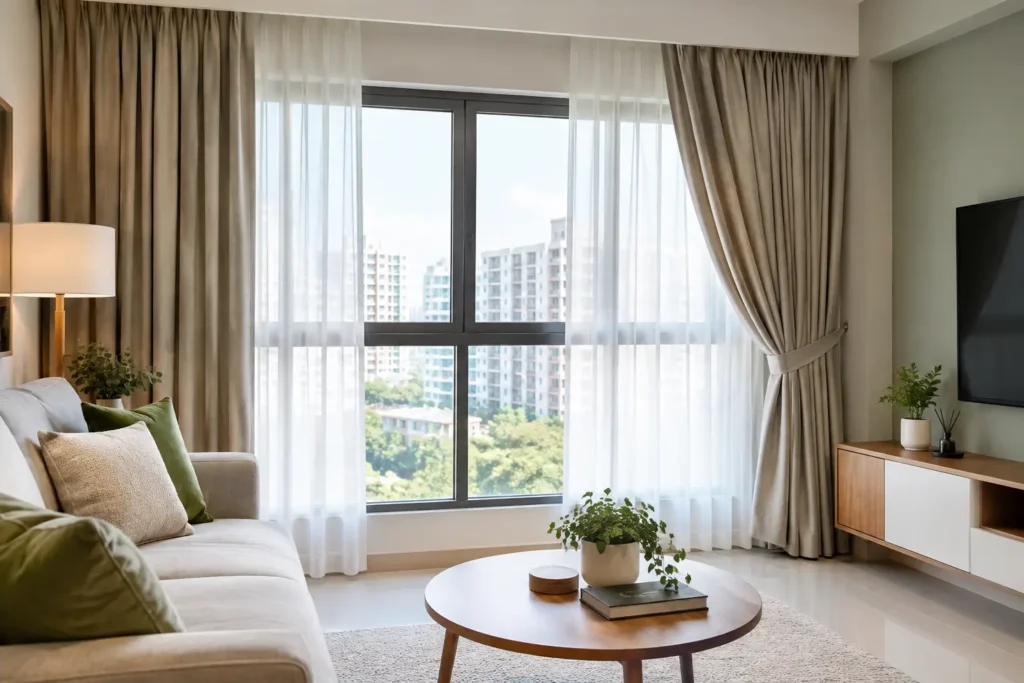
HDB Curtain Ideas: Day and Night Curtains for Living Rooms
The sheer layer filters harsh daylight and reduces the feeling of being overlooked. A second night curtain adds privacy after sunset and provides stronger light control when needed.
You can leave the sheer closed during the day while keeping the room bright. Later, draw the night curtain when stronger coverage is required. This flexibility makes a double-curtain arrangement especially useful for living rooms facing neighbouring blocks.
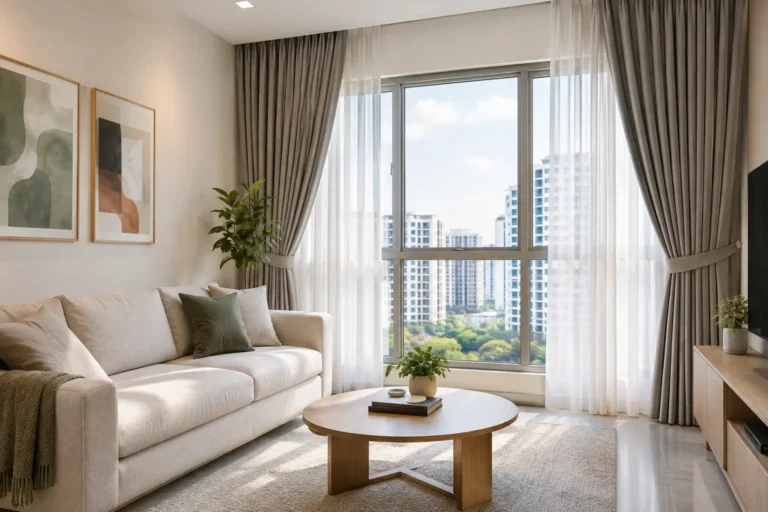
HDB Curtain Ideas: Sheer Curtains for Daytime Privacy
Sheer curtains soften direct sunlight without making an HDB living room feel enclosed. They can also reduce glare on television screens and create a lighter visual finish across wide windows.
However, a sheer curtain should not be treated as complete privacy protection. During the day, a denser weave can reduce visibility from outside while preserving useful daylight. At night, indoor lighting can make silhouettes and movement more visible.
If evening privacy matters, pair the sheer with a night curtain or another opaque window covering.
The weave also changes the result. An open, lightweight sheer admits more daylight but offers less screening. A denser privacy sheer gives greater discretion and may soften the view of nearby blocks more effectively.
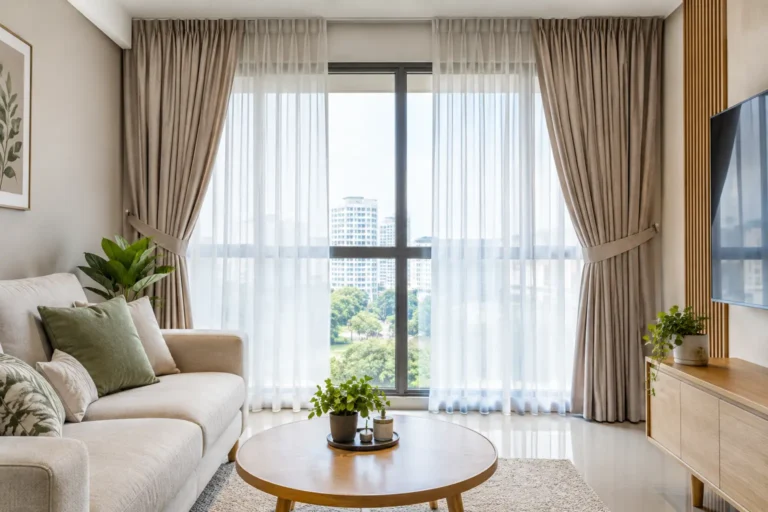
HDB Curtain Ideas: Ripple Fold Curtains for Modern Homes
Ripple fold curtains, sometimes called S-fold curtains, suit modern HDB and BTO interiors because they form consistent waves across the window.
They work particularly well with ceiling-mounted tracks. The full-height appearance can make a standard-height room feel taller and gives the window wall a clean architectural finish.
Nevertheless, ripple fold curtains require enough stack-back space. Their waves remain formed when the curtain is open, so the parked fabric can occupy more width than homeowners expect.
Where wall space is limited, adjust the track layout, fabric fullness or curtain opening direction. In some cases, a blind may preserve more usable glass.
HDB Curtain Ideas for Bedrooms: Dim-Out or Blackout?
Bedrooms usually need stronger privacy and light control than living areas. Therefore, the key decision is often whether to choose a dim-out or blackout curtain.
Dim-out fabric reduces a significant amount of daylight without aiming for near-darkness. It can work well for bedrooms where some morning light is acceptable.
Blackout fabric blocks much more light through the fabric itself. It is particularly useful for shift workers, young children, media use or bedrooms exposed to bright street lighting and sunrise.
Blackout fabric does not eliminate every light gap
A blackout curtain can make an HDB bedroom much darker, but fabric alone does not determine the result.
Light may still enter above the track, between centre panels, along the sides or below the hem. Track position, curtain overlap and window geometry all affect room darkening.
For stronger coverage, extend the curtain beyond both sides of the window where possible. A ceiling-mounted track can also reduce the visual gap above the curtain compared with a track installed lower on the wall.
A double-track arrangement allows a sheer to remain closed during the day while the blackout curtain stays open. At night, the heavier curtain provides privacy and room darkening.
Do not overlook fabric colour and visual weight
In a compact HDB bedroom, a very dark and heavy curtain can dominate the room. Lighter neutral blackout or dim-out fabrics often feel less visually bulky while still providing effective coverage.
Always view fabric samples in the actual room where possible. Tropical daylight can make colours and textures appear very different from showroom lighting.
HDB Curtain Ideas for Small Spaces: When Blinds Make More Sense
One of the most practical HDB curtain ideas is knowing when not to use curtains at all.
Blinds take up less space around the window and can suit rooms where a desk, cabinet, bed or kitchen counter sits nearby. They also avoid the large fabric stack created by full-height curtains.
Roller blinds for compact and practical spaces
Roller blinds have a simple profile and use one continuous fabric panel. They work well for studies, kitchens, service-yard-adjacent areas and smaller bedrooms.
Sunscreen roller fabrics can reduce glare while retaining some outward visibility during the day. Dim-out and blackout fabrics provide stronger coverage when privacy or darkness matters more.
For a home office, a sunscreen roller blind can be particularly useful when direct sunlight hits a computer screen.
Korean or combi blinds provide adjustable daytime control
Korean blinds, also known as combi or zebra blinds, use alternating sheer and opaque bands. Adjusting the bands changes the amount of daylight and privacy without fully raising the blind.
Their compact design can suit living rooms, bedrooms and study areas where homeowners want more flexibility than a standard roller blind.
However, they may not be the first choice when near-blackout performance is the main priority.
Honeycomb blinds suit windows where compact stacking matters
Honeycomb blinds have a cellular structure and a neat, compact appearance. They can work well in bedrooms, study areas and windows where a full curtain would occupy too much surrounding space.
Material and operating style still matter. Consider the room’s humidity, cleaning requirements and how often the blind will be raised and lowered.
Venetian blinds offer precise light control
Venetian blinds use adjustable horizontal slats, allowing more directional control of daylight than a fixed fabric panel.
You can tilt the slats to reduce glare while still allowing daylight into the room. This makes them useful for studies, living areas and some service spaces.
The trade-off is maintenance. Slats need regular dusting, so the household should be comfortable with the cleaning involved.
HDB Curtain Ideas: Curtains or Blinds for Different Spaces?
There is no single answer because curtains and blinds solve different problems.
Curtains generally create a softer and more furnished appearance. They work especially well across larger living-room and bedroom windows, where full-height fabric can visually soften the entire wall.
Blinds have a more compact profile. They are often easier to integrate with desks, cabinets and smaller windows where curtain stack-back would reduce usable space.
Some HDB homes benefit from using both. For example, the living room may use full-height day and night curtains, while the study uses a roller blind and the service area uses Venetian blinds.
Instead of forcing one style throughout the flat, choose according to the purpose of each window.
Curtain Tracks Matter More Than Many Homeowners Expect
The curtain track affects appearance, everyday operation and light control.
Ceiling-mounted tracks create a taller visual line and work particularly well with ripple fold and full-height curtains. Wall-mounted tracks may be more suitable where beams, false ceilings or other site conditions limit ceiling installation.
Day and night curtains require a double-track system so both layers can move independently.
Opening direction also matters. A wide living-room window may suit centre opening, while a balcony entrance may work better with a one-way draw that keeps the access side clear.
Track quality becomes more important as curtains become wider and heavier. A properly supported track should allow smooth operation without excessive pulling or strain.
HDB Curtain Ideas for Wide or Hard-to-Reach Windows
Motorised curtains can be useful for wide living-room windows, high windows and curtain spans that homeowners open and close several times each day.
Motorised curtain systems can operate through remote controls, wall controls or compatible smart-home systems, depending on the selected setup.
Convenience is not the only advantage. Easy operation can encourage homeowners to adjust their curtains more regularly throughout the day instead of leaving large panels permanently closed.
Plan motorisation before installation wherever possible. The track needs a suitable power or battery arrangement, and the motor position must work with the curtain stack, pelmet and nearby carpentry.
For a small guest-room window that is rarely adjusted, a quality manual track may remain the simpler option.
HDB Curtain Ideas by Room
Living room
For most living rooms, start with daytime privacy and glare control. Day and night curtains are a flexible option, particularly for windows facing nearby blocks.
If the room is small, choose lighter colours and make sure the curtain has enough stack-back space when open.
Master bedroom
A sheer and blackout combination offers flexibility throughout the day. The sheer provides daytime screening, while the blackout curtain gives stronger privacy and room darkening after sunset.
Plan the track position carefully when light control is a priority.
Common and children’s bedrooms
Choose durable fabrics that suit regular use. Blackout curtains can help where early morning light or afternoon naps are an issue, while lighter dim-out fabrics may suit rooms where complete darkness is unnecessary.
Keep long curtain panels clear of furniture where possible.
Study or home office
Screen glare often matters more than darkness in a study. Roller blinds, Venetian blinds or a sheer-and-dim-out arrangement can all work depending on sun direction.
If a desk sits directly below the window, a compact blind may be more practical than floor-length curtains.
Kitchen and service areas
Avoid placing long fabric curtains close to cooking vapours, splashes or frequently damp areas.
An easy-care blind is usually more practical where the material can be maintained according to its cleaning requirements.
Check HDB Guidelines Before Finalising Window Works
For ordinary internal window furnishings, the requirements are straightforward. The Housing & Development Board’s renovation guidelines currently state that installing curtain rails or Venetian blinds internally does not require a renovation permit.
Different conditions can apply to certain balcony installations or works involving the windows themselves. Therefore, homeowners should check the latest HDB requirements where the proposed work goes beyond a normal internal curtain or blind installation.
Keep Maintenance Practical
A window treatment should remain easy to live with after renovation day.
Vacuum curtains gently with a soft brush or suitable upholstery attachment to reduce dust. Follow the selected fabric’s cleaning instructions because improper washing can shrink fabric or change the appearance of pleats and folds.
Blinds also need maintenance according to their construction. Roller blinds have a relatively simple surface, while Venetian slats and layered combi blinds require more detailed dusting.
Households with children, pets or frequently opened windows may prefer durable materials that tolerate everyday handling.
Maintenance should influence the original product choice rather than becoming an afterthought.
Frequently Asked Questions About HDB Curtain Ideas
What curtains are suitable for an HDB living room?
Day and night curtains are a versatile choice for many HDB living rooms. The sheer layer provides filtered daylight and daytime screening, while the night curtain adds privacy and stronger light control after dark.
Are curtains or blinds better for a small HDB flat?
Both can work. Curtains provide a softer full-height finish, while blinds use less space around the window. If furniture or built-in carpentry sits close to the glass, a blind may preserve more usable space.
Are sheer curtains private enough for an HDB flat?
Sheers can provide useful daytime screening, especially with a denser weave. However, they do not provide dependable night privacy when the room is illuminated. Pair them with a night curtain where evening privacy matters.
Do blackout curtains make an HDB bedroom completely dark?
Blackout fabric blocks a high level of light through the material, but gaps around the curtain can still admit light. Track position, overlap, side coverage and curtain length all affect the final result.
Are ripple fold curtains suitable for small HDB rooms?
Yes, provided there is enough stack-back space. Their regular waves create a clean full-height appearance, but the folded fabric still occupies wall width when open. Measure the available space before confirming the style.
Should I choose motorised curtains for an HDB?
Motorisation is most useful for wide, high or frequently operated curtains. For smaller windows that are easy to reach, a quality manual system may be more economical.
Choose Window Treatments Around Daily HDB Living
The strongest HDB curtain ideas solve practical problems before they solve decorative ones.
Start by identifying what each window needs: daytime privacy, less glare, better room darkening, a clearer view or more usable space around nearby furniture. From there, decide whether curtains, blinds or a combination gives the most practical result.
At Sincere Interior, we consider fabric choice, track position, curtain fullness, stack-back and window conditions together during consultation and site measurement.
Serving Singapore since 1976, our made-to-measure curtains are produced by our in-house team in Singapore, with professional measurement and installation for residential and commercial projects.
For an HDB or BTO flat, a carefully planned window treatment should make the home easier to live in every day. It should give you the privacy and light control you need without making the room feel smaller or harder to use.
SINCERE INTERIOR
Need Help Choosing the Right Curtains?
Not sure which curtain style, fabric or system suits your home?
Speak with our team for personalised recommendations for your space.
Discover the best curtains for Singapore humidity, with practical guidance on fabric choices, mould prevention and care for homes, offices and commercial…


 0