0
0

Motorised Curtain Systems Singapore: What to Look For
Read motorised curtain system reviews with clear advice on tracks, fabrics, smart controls, fitting, light control and long-term use for Singapore homes.
READ MORE →

A new BTO flat can look very different once the afternoon sun hits the living room, the neighbouring block faces your bedroom, or your child starts waking at first light. That is why choosing curtains for BTO flats is not simply a finishing touch after renovation. The right window furnishing affects privacy, sleep, comfort, cleaning and how spacious each room feels.
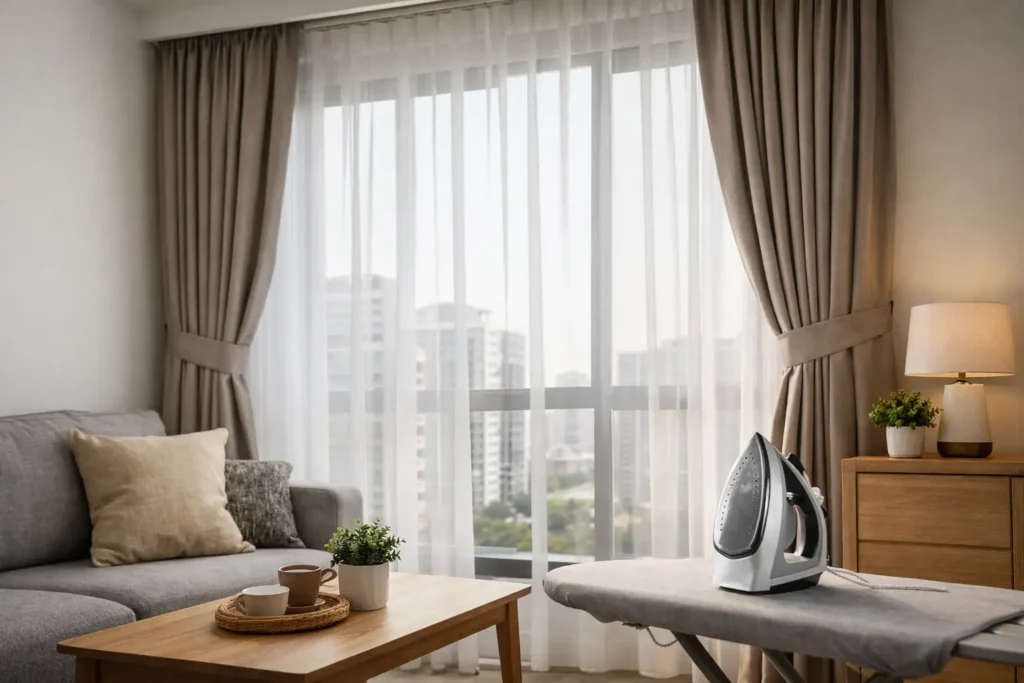
For most BTO homeowners, the most practical starting point is to decide what each window needs to do. A living room may need soft daylight and daytime privacy. A bedroom usually needs stronger light control. The service yard may need a moisture-resistant option that is easy to wipe down. Once these needs are clear, choosing a fabric, track and style becomes much easier.
BTO flats vary in layout, but many have large living-room windows, standard bedroom windows and close-facing neighbouring units. Do not choose curtains based only on a fabric sample or a showroom display. Consider where the sun enters, how much privacy the room needs and whether furniture will sit close to the window.
A west-facing living room can receive intense late-afternoon light and heat. Singapore’s National Environment Agency also recommends using curtains or blinds to help block unwanted solar heat, particularly for windows exposed to stronger sunlight. Sheer curtains will soften glare, but they will not provide full privacy at night. In this situation, a day and night curtain combination is often a sensible choice: sheers for the day, with a lined or blackout curtain for the evening.
For a room facing a corridor, another block or a common area, privacy may matter more than direct sunlight. A denser sheer, roller blind or Korean blind can be useful during the day, while night curtains provide coverage after dark. The best solution depends on the viewing angle. A professional site measurement helps identify these details before anything is produced.
A single curtain style throughout the flat can create a coordinated look, but it does not always meet every room’s needs. It is usually better to keep the colour palette consistent while selecting the window treatment according to function.
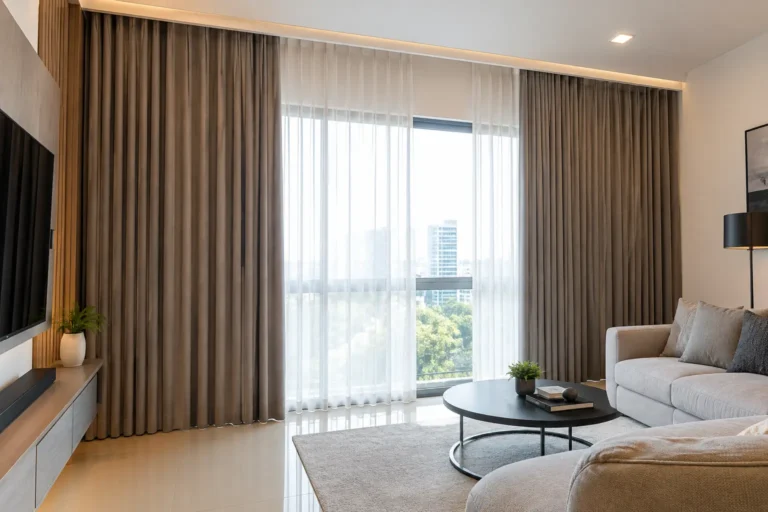
The living room is where many BTO homeowners choose day and night curtains. A light-filtering sheer allows daylight in while reducing direct views from outside. A fuller night curtain then provides privacy and a more finished appearance in the evening.
Ripple-fold and S-fold curtains are popular for BTO living rooms because their regular waves look neat without appearing overly formal. They work particularly well across wide windows and balcony doors. The trade-off is that curtains need enough stacking space at the sides when open. This should be allowed for when planning feature walls, display cabinets or air-conditioning trunking.
If the living room is compact, choose lighter fabrics and mount the track close to the ceiling where suitable. Full-height curtains can make the room feel taller. Very heavy, dark fabrics may provide a dramatic look, but can visually reduce a smaller space.
Bedrooms generally benefit from blackout curtains, especially for families with young children, shift workers or anyone sensitive to early morning light. Blackout performance comes from the fabric, lining, gaps around the sides and the way the curtain is installed. A blackout fabric alone cannot eliminate all light if the track and curtain width are not planned properly.
For a main bedroom, sheers with blackout night curtains offer flexibility. During the day, the sheer maintains privacy without making the room feel shut in. At night, the blackout layer helps create a darker resting environment.
In a child’s room, durability and ease of use are worth considering alongside colour. A practical, washable fabric in a calm shade often serves better than a highly decorative fabric that may date quickly. Avoid cords that are within easy reach of young children, and ask about suitable track or blind operating options.
Long fabric curtains are usually not the first choice around cooking areas or service yards. Roller blinds, Venetian blinds or outdoor blinds may be more practical, depending on exposure. These options take up less space, are easier to clean and are less likely to catch cooking fumes or moisture.
For a service yard, consider ventilation, rain exposure and the position of laundry racks. Outdoor blinds can provide shade and privacy, but the material and fitting must suit the area. The aim is not to seal the space completely, as airflow remains important in Singapore’s humid climate.
Curtain fabrics are often described as sheer, dim-out or blackout. These terms are useful, but they should be understood in practical terms.
Sheer fabrics diffuse sunlight and give daytime privacy, particularly when it is brighter outside than indoors. At night, however, a lit room can be visible through most sheers. They should be paired with a night curtain or blind where night-time privacy is needed.
Dim-out curtains reduce a substantial amount of light but may not darken a room fully. They suit homeowners who want softer light control without the weight or darkness of full blackout fabric. Blackout curtains are better for bedrooms, media rooms and spaces exposed to strong light, although a small amount of light can still enter around the edges.
Colour also changes the result. Pale curtains reflect light and create an airy appearance, while darker shades can make the room feel more enclosed but may offer a stronger visual barrier. Fabric texture matters too. Linen-look fabrics bring warmth and a relaxed feel, whereas smoother fabrics can suit a cleaner, more contemporary interior.
When planning curtains for BTO flats, track position and accurate measurement are just as important as fabric choice. In BTO homes, curtain tracks may need to work around false ceilings, pelmets, air-conditioning units, window handles and built-in carpentry.
Ceiling-mounted tracks are often preferred for full-height curtains because they create a clean vertical line. Wall-mounted tracks may be necessary where there is insufficient ceiling clearance or an existing bulkhead. Neither is automatically better. The correct choice depends on the window and renovation details.
Curtain length also deserves attention. For most living rooms and bedrooms, curtains that finish close to the floor look more tailored and are easier to maintain than curtains that puddle on the floor. In rooms where moisture or frequent cleaning is a concern, a small clearance above the floor can be more practical.
Made-to-measure curtains allow the fabric width, fullness, track length and drop to be planned for the actual window rather than guessed from standard sizes. This is particularly useful for irregular windows, wide sliding doors and BTO layouts where space at the sides is limited.
Curtains and blinds solve different problems. Curtains bring softness, improve the sense of height and offer flexible layering. Blinds are generally more compact and can be a practical option where furniture sits close to the window.
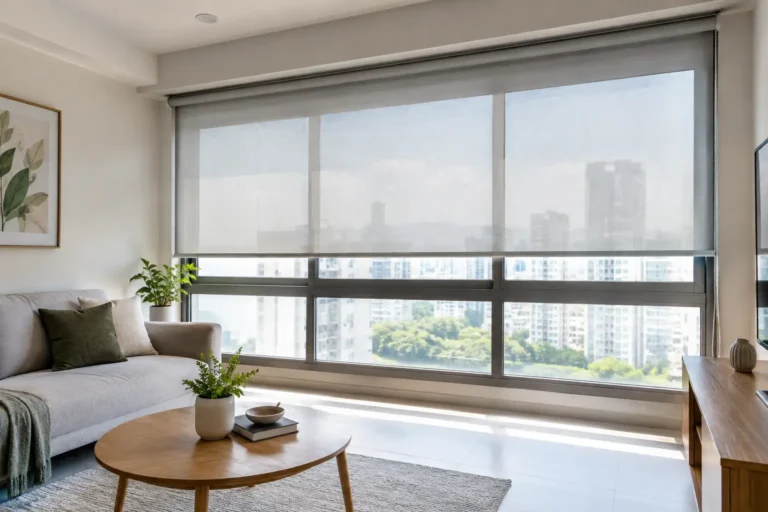
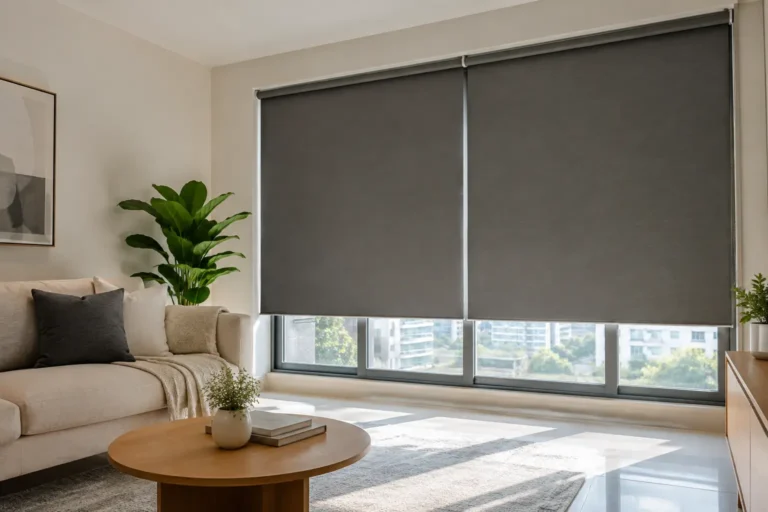
Roller blinds work well in kitchens, study rooms and bedrooms where a neat, minimal look is preferred. Venetian blinds provide adjustable light control, but their slats need regular dusting. Korean blinds offer alternating sheer and opaque panels, allowing light adjustment without raising the blind fully. Roman blinds give a softer fabric look but are usually best for smaller windows rather than wide living-room openings.
Motorised curtains and blinds are worth considering for hard-to-reach windows, wide curtain runs or households that value convenience. They can be operated by remote control, wall switch or compatible smart-home systems. Motorisation adds cost and requires proper planning for power supply, but many homeowners find it useful for daily living and for keeping heavy curtains moving smoothly.
The cost of curtains for BTO flats depends on window size, fabric grade, lining, fullness, track type, installation complexity and whether motorisation is included.
When comparing quotations, check what is included: fabric, sewing, tracks or brackets, installation, transport and warranty coverage. Also ask whether the measurements are taken on site. Accurate measurement before production reduces the risk of avoidable gaps, dragging hems or tracks that conflict with carpentry.
It can be sensible to prioritise the living room and bedrooms first, then complete less critical areas later. However, if the renovation has a false ceiling or concealed curtain pocket, plan the track position before renovation work is finalised. Retrofitting later can be possible, but may limit the neatest installation options.
Bring your floor plan, renovation drawings and a few reference images to a curtain consultation. More importantly, explain how you live in the flat: whether you work from home, have children, need daytime privacy, watch films in the afternoon or prefer to open windows often. These everyday details often lead to a better recommendation than following a trend.
When choosing curtains for BTO flats, a practical room-by-room approach usually gives a better result than following one style throughout the home. Serving Singapore since 1976, Sincere Interior Service supports homeowners from fabric selection and professional site measurement through Singapore-based custom production, installation and post-installation support.
Not sure which curtain style, fabric or system suits your home? Speak with our team for personalised recommendations for your space.
GET IN TOUCH →