0
0

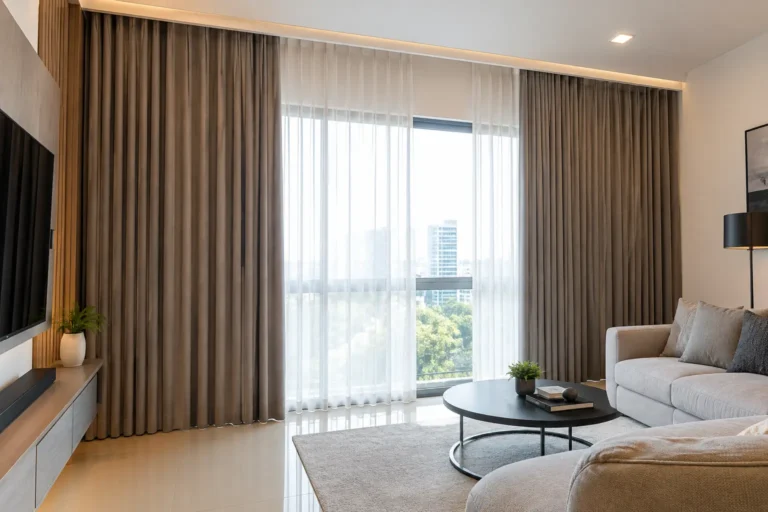
Motorised Curtain Systems Singapore: What to Look For
Read motorised curtain system reviews with clear advice on tracks, fabrics, smart controls, fitting, light control and long-term use for Singapore homes.
READ MORE →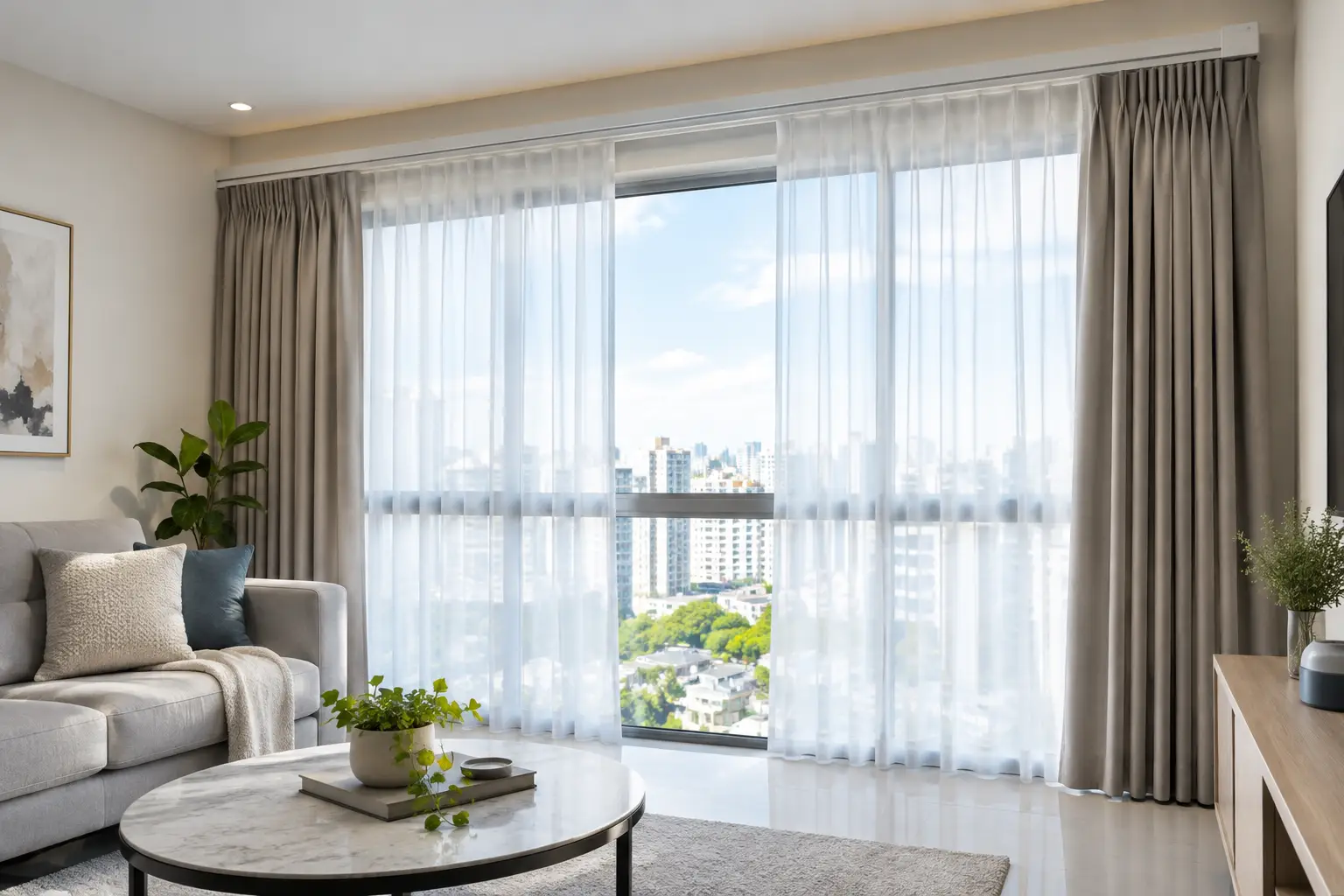

Motorised curtain tracks are most useful for wide, tall or hard-to-reach windows, or where homeowners open and close the curtains several times a day. In Singapore homes, they can make full-height condominium glazing, day and night curtains, double-volume windows and hard-to-reach openings easier to manage for privacy, daylight and everyday comfort.
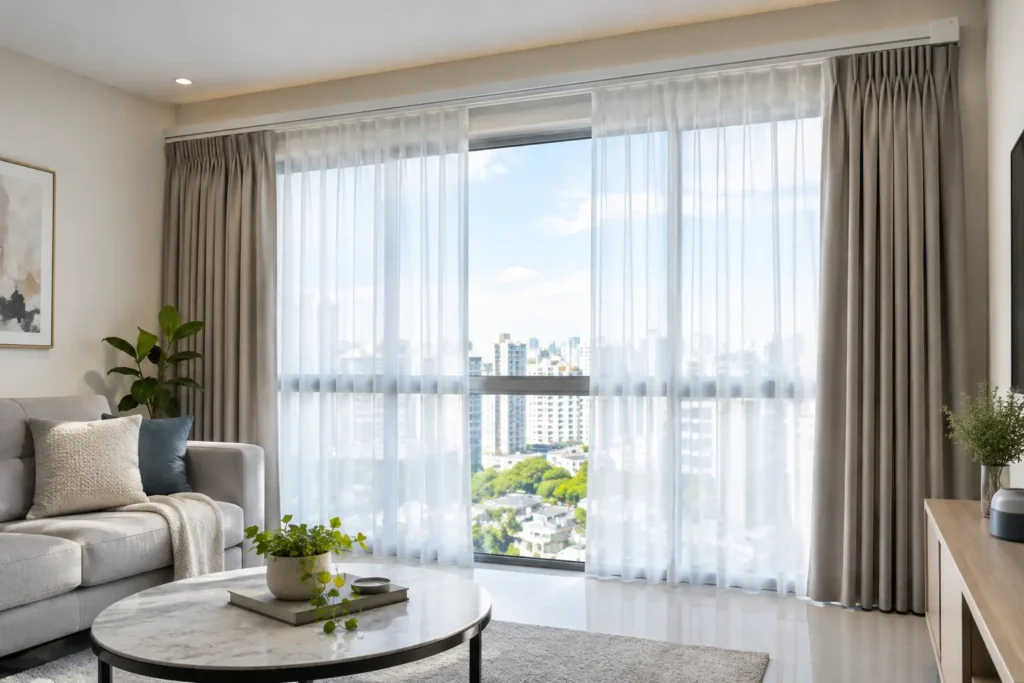
A reliable motorised curtain system depends on more than the motor itself. Track layout, curtain weight and fullness, stack-back space, power provision, control method and installation all need to work together. This guide explains what homeowners should plan before choosing motorised curtain tracks in Singapore.
For most homes, motorised curtain tracks are most worthwhile for wide, tall, heavy or frequently used curtains. For smaller windows that are easy to reach, a well-fitted manual track can remain the simpler and more economical choice.
A motorised curtain track uses an electric motor to move curtains along a fitted track. Depending on the system, homeowners can operate it by remote control, wall switch, mobile app or smart-home integration. Select the motor, track, curtain weight and control method as one coordinated system.
See a completed Sincere Interior motorised curtain, demonstrating the system’s smooth operation in a real project setting.
For a homeowner, the practical benefit is simple: the motor moves the curtains without repeated fabric handling or reaching across furniture. This is helpful when a sofa, bed or built-in carpentry sits close to the window. It also reduces repeated handling of delicate sheer fabrics, which can become marked or snagged over time.
Motorised curtain tracks are commonly paired with ripple fold or S-fold curtains because these headings travel neatly and maintain an orderly wave. They can also be used with other suitable curtain styles, but the heading, fabric weight and fullness should be assessed before installation.
Motorisation is most worthwhile when it solves a real daily inconvenience. In a BTO or HDB flat, it may be a living-room window behind a dining table or a bedroom bay window partly blocked by the bed. For condominiums, motorised curtains are especially useful for full-height glazing exposed to strong afternoon sun. In landed homes and commercial spaces, high or unusually wide windows can make manual operation impractical.
It can also support a more regular routine. Homeowners can open sheer curtains in the morning for daylight, then close them when the room is unoccupied. Night curtains can be drawn before sunset for privacy, particularly in homes facing nearby blocks. Scheduling can be convenient, but it should not be the only reason for choosing motorisation. A properly fitted manual track remains a sensible option for smaller, easily reached windows.
Bedrooms are another common application. A motorised blackout curtain lets occupants close the room without getting out of bed, which is useful for shift workers, young children or anyone sensitive to early light. Still, the curtain fabric alone does not determine darkness. Light can enter at the top, sides and between two centre-drawing panels, so track placement and overlap matter.
A motor cannot compensate for a poorly planned track. Before selecting a system, the installer should consider the window width, curtain drop, fabric weight, number of layers and how far the curtains need to stack when open.
A single track suits one curtain layer, such as a dim-out or blackout curtain in a bedroom.Use a double track for day and night curtains, with sheers on one track and the heavier night curtains on the other. Homeowners can motorise either layer, although many choose the night curtain first when they operate it more frequently.
For a living room, motorising both curtain layers provides the greatest convenience. The sheer can soften glare while preserving daytime brightness. Homeowners can close the night curtain later for privacy. The trade-off is a deeper track arrangement, which needs sufficient ceiling or pelmet space.
When curtains open, the fabric gathers at the sides of the window. Installers call this gathered area the stack-back. A thick blackout fabric, generous curtain fullness or wide ripple fold heading requires more stack-back than a lightweight sheer.
This matters in compact flats where every portion of glass is valuable. If the track is too short, opened curtains may cover part of the window and reduce the view or daylight. Extending the track beyond the window, where wall space allows, gives the curtains somewhere to sit when open. It is a small planning detail that makes the room feel more open in daily use.
Bay windows, L-shaped glazing and curved walls require extra attention. Some track systems can accommodate bends or joins, but the curtain must still travel smoothly through the layout. Complex shapes may require separate curtains or motors rather than one long run.
A site measurement is the right time to identify these limits. Photos and floor plans are useful for an initial discussion, but they do not always show beam positions, uneven ceilings, curtain-box depth or obstructions near the window.
Most curtain fabrics work on a motorised track when the installer selects the track and motor for the correct load. The real question is whether the fabric suits the room as well as the system.
Sheer curtains are light, easy to operate and well suited to Singapore homes where glare control is needed without making the room feel closed in. They offer daytime privacy to a degree, but at night, when interior lights are on, they do not provide reliable privacy on their own.
Dim-out curtains reduce light but do not fully block it. They can be a comfortable choice for living rooms, studies or bedrooms where a softly darkened environment is enough. Blackout curtains are more suitable for stronger light control, but expectations should be realistic. Even blackout fabric cannot eliminate light gaps if the track is installed away from the wall, the curtain does not overlap adequately, or an exposed pelmet design leaves light entering from above.
Heavier fabrics may improve drape and light control, but they take up more stack-back space and place a greater load on the system. Check very textured, stiff or loosely woven materials carefully to ensure they form folds and move smoothly along the track. Choose the fabric, curtain heading and track together rather than treating them as separate decisions.
For new renovations, plan motorised curtain tracks before contractors complete the ceiling and electrical works. A concealed power point within a curtain box or near the track gives a neater finish and avoids visible cables. This is especially relevant where a false ceiling, pelmet or recessed curtain pocket is being built.
Retrofitting is still possible in many completed homes. The suitable approach depends on power access, whether visible trunking is acceptable and where installers can secure the track safely. A battery-operated option may suit certain windows, but it introduces the need for charging or battery management. Wired systems avoid that routine, provided electrical planning is feasible.
Control options should match the household and the selected motor system. In Singapore projects, common integration methods include Wi-Fi, Zigbee and dry-contact control, depending on the motor and home-automation system. Many Singapore projects use Tuya-based Wi-Fi or Zigbee setups for app-based control, while compatible systems may also integrate with platforms such as Google Home or Apple Home. Somfy uses its own TaHoma hub and app ecosystem for compatible motorised curtains, blinds and other connected equipment. Always confirm the motor, controller, hub and smart-home compatibility before purchase rather than assuming every system will work together.
Motorised tracks need firm, level fixing. The ceiling or supporting structure must be suitable for the track, fabric and motor weight. Concealed track installations also need enough clearance for the curtain heading to move without rubbing against a pelmet, air-conditioning bulkhead or window handle.
Adjust the curtains so they meet and overlap correctly when closed. For centre-opening curtains, this helps reduce the visible gap between panels. For one-way opening curtains, the chosen stacking side should not interfere with a wardrobe, feature wall, balcony door or window access.
After installation, basic care is straightforward. Keep the track free from renovation dust, avoid pulling a motorised curtain by hand unless advised otherwise, and follow the fabric care instructions for cleaning. If you remove the curtains for washing, rehang them carefully so the heading and runners remain evenly spaced.
The most suitable motorised setup depends on how you use the room. A bedroom may need a double track with sheer and blackout curtains, while a study may be better served by a light-filtering blind if precise glare control is the priority. For sliding doors, curtains often provide a practical wide-span solution, but the stack-back should not obstruct the opening.
At Sincere Interior Service, motorised curtain planning begins with the actual window, room use and installation conditions rather than a standard motor package. Serving Singapore since 1976, our team assesses track length, curtain fullness, fabric weight, stack-back, power access and control requirements before recommending a suitable system. Professional site measurement, Singapore-based custom production and installation help ensure that the curtain, track and motor work together properly for everyday use.
Not sure which curtain style, fabric or system suits your home? Speak with our team for personalised recommendations for your space.
GET IN TOUCH →