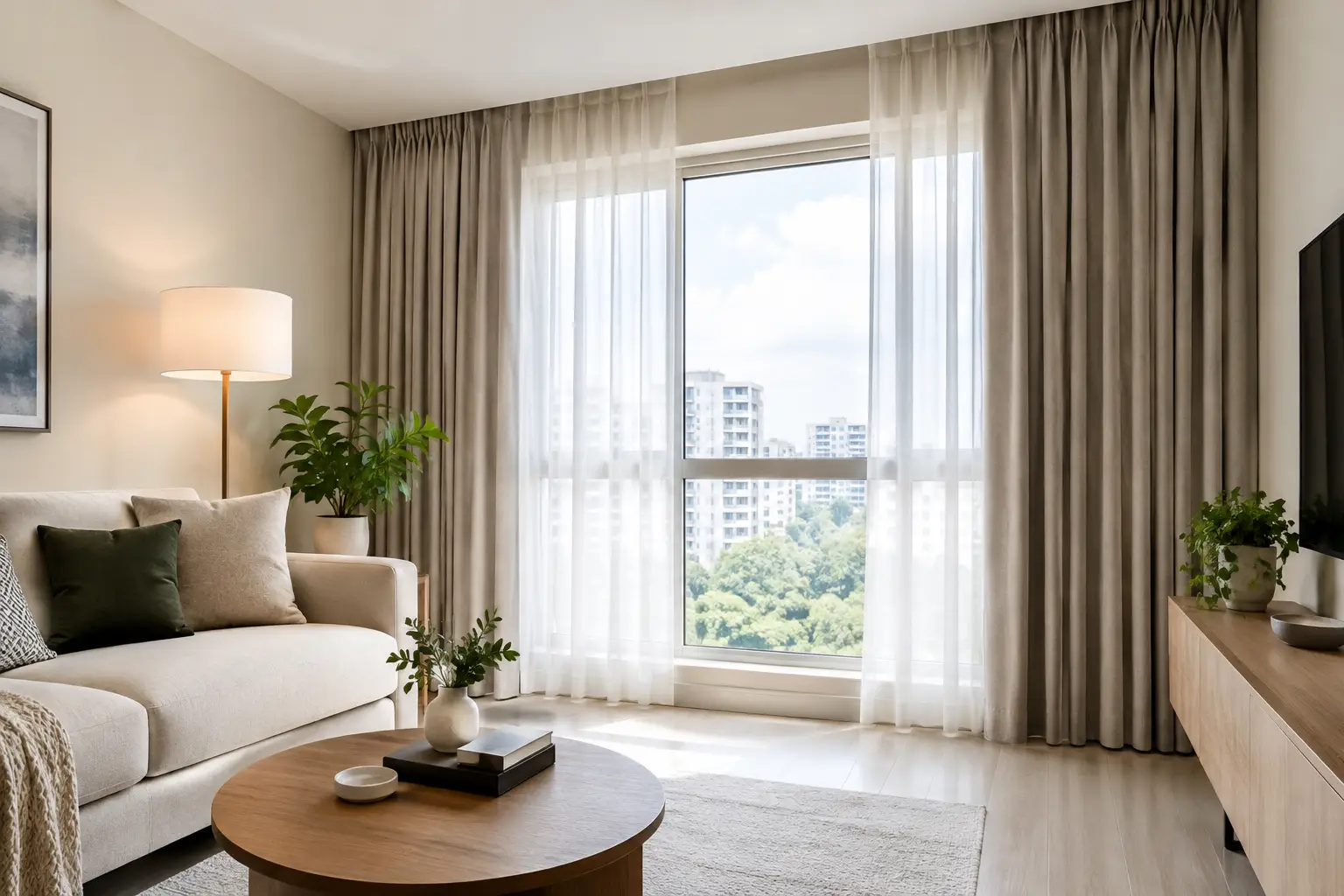
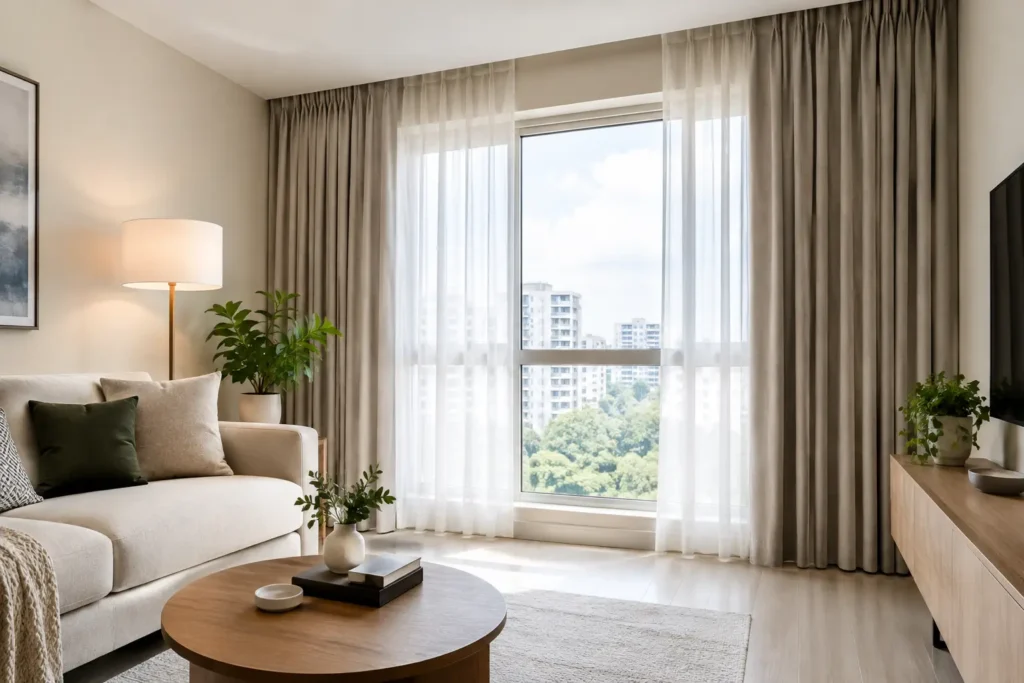
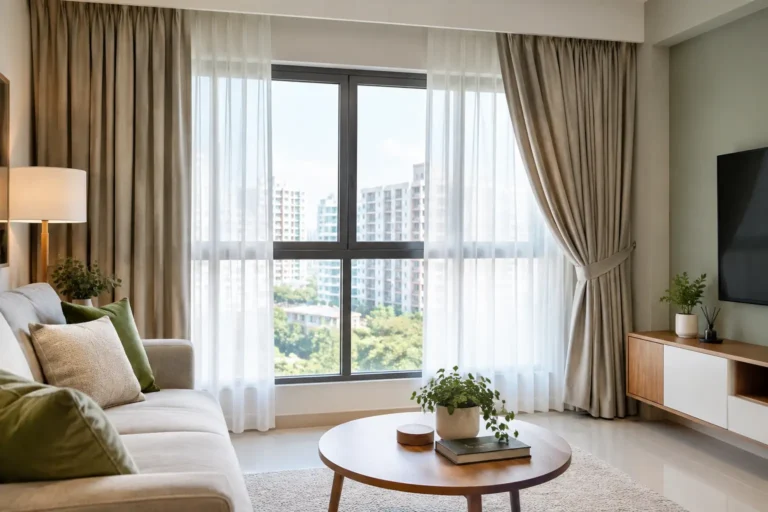
A curtain can look substantial in a showroom yet feel too stiff, too sheer or too warm once it is hanging across your own window. Choosing curtain fabrics is therefore not only about colour or pattern. The fabric affects privacy, daylight, drape, cleaning, stack-back space and how well the finished curtains suit the way you use each room.
For homes in Singapore, strong afternoon sun, close neighbouring blocks and humid conditions all deserve consideration. A good fabric choice begins with what the window needs to do, then works back to the look you want.
Curtain fabrics should be chosen around four practical needs: light control, privacy, drape and maintenance. Sheers suit softened daylight and daytime privacy, dim-out fabrics reduce brightness without fully darkening a room, while blackout fabrics work better where stronger darkness is needed. Textured and linen-look fabrics add softness and depth, but their weave, weight and care requirements should still suit the room and window.
Choosing Curtain Fabrics: Start with Function, Not the Swatch
The same fabric will not suit every room. A bedroom may need darkness and privacy, while a living room may benefit from softened daylight without cutting off the view. For a study, the priority may be reducing screen glare; for a balcony-facing window, it may be managing heat and privacy while keeping the space bright.
Before selecting a colour, consider when direct sun enters the room, whether people can see into the home at night, and how often the curtains will be opened. Also look at the window itself. A wide living-room opening, a bay window and a compact BTO bedroom window each have different limits on track position and curtain stack-back.
A fabric that is attractive but impractical can become frustrating quickly. Heavy curtains on a small window may take up too much wall space when open. Very light sheers can offer daytime softness but little privacy after dark. The right answer is often a day-and-night combination rather than a single curtain layer.
Understanding common curtain fabric types
Homeowners should choose curtain fabric by considering its weave, weight, opacity and finish. These qualities matter more than a fabric label alone.
For households that also consider textile certification, OEKO-TEX STANDARD 100 covers home textiles such as curtains and tests certified products for a wide range of harmful substances.
Sheer fabrics
Sheers filter harsh daylight and create a softer view through the window. They are especially useful in living rooms, dining areas and condominiums with large glazing, where homeowners want daylight without leaving the room fully exposed during the day.
A sheer curtain does not provide dependable privacy at night when interior lights are switched on. Homeowners usually pair a sheer with a dim-out or blackout curtain when another block, corridor or neighbouring property overlooks the room. Denser sheers can reduce visibility more effectively in daytime, but they still should not be treated as a night privacy solution.
Dim-out fabrics
Dim-out fabrics reduce incoming light but do not fully block it. They are a practical choice for living rooms, family areas and bedrooms where a softer, less enclosed feel is preferred. They can reduce glare and make a room more comfortable during sunny periods, while retaining a lighter drape than some blackout options.
Light will still enter through the fabric and around the sides, top and bottom of the curtains. If someone is sensitive to early morning light, works night shifts or is furnishing a nursery, dim-out may not be sufficient on its own.
Blackout fabrics
Homeowners commonly choose blackout curtains for bedrooms, media rooms and spaces exposed to intense sun because they provide stronger light control. The blackout effect may come from a coated backing, a tightly constructed multi-layer fabric or a separate lining.
However, blackout fabric alone does not create a completely dark room. Light gaps at the curtain sides, above the track and where two panels meet can still be noticeable. Accurate measurement, suitable track placement and sufficient curtain overlap are just as important as the material. This is particularly relevant in HDB and BTO bedrooms where windows may sit close to a wall or wardrobe.
Some blackout materials feel firmer and hang differently from unlined fabrics. A good consultation should account for the desired fullness and heading style, so the curtains retain a neat appearance rather than looking bulky.
Textured, woven and linen-look fabrics
Textured fabrics add depth without relying on a bold print. Homeowners often choose linen-look materials, soft weaves and subtle jacquards for a relaxed, layered look. They can work well with ripple fold or S-fold curtains because the repeated waves show off the fabric’s surface.
Natural-looking fabrics may have a more open weave, which can allow more light through than expected. Ask to view the fabric against daylight rather than judging it only under showroom lighting. In a west-facing room, the difference between a lightly textured dim-out and a true blackout fabric can be significant.
Curtain fabrics by room and window condition
A living room often benefits from a sheer layer with a separate night curtain. During the day, the sheer softens glare and offers some privacy while maintaining a bright atmosphere. In the evening, the night curtain gives privacy and a more finished look. For full-height windows, ensure there is enough wall space for the curtains to stack back without covering too much glass when open.
For bedrooms, choose based on sleeping habits rather than appearance alone. A dim-out curtain may be comfortable for households that wake naturally with daylight. Blackout curtains are more suitable where sun enters early, street lighting is present or occupants need a darker environment. If ventilation is regularly needed, consider how far the curtain panels must travel to clear the opening.
In a study or home office, glare control should guide the selection. Sheers can diffuse daylight, but they may not be enough for a desk facing a bright window. Depending on the window layout, roller blinds or honeycomb blinds may give more precise light adjustment. Curtains remain a good option where acoustics, warmth and a softer residential look are priorities.
For dining rooms and common areas in compact flats, avoid assuming that dark or heavy fabric is the only route to privacy. A well-chosen sheer plus a neutral night curtain can keep the room visually open. Lighter tones also tend to show less dust than very dark fabrics, although texture and weave make a difference.
Landed homes and properties with wide windows may require longer tracks, joined track sections or motorised operation. Here, fabric weight matters. A broad expanse of lined blackout curtains can be heavy, so track capacity, bracket placement and smooth operation should be assessed before installation.
Fabric behaviour affects the finished look
Curtain makers add fullness by using more fabric width than the window itself. This allows the material to form folds when closed. The amount of fullness depends on the fabric, heading style and the desired appearance. A soft sheer usually needs more fullness to look generous, while a thick blackout material may need less to avoid excessive bulk.
Ripple fold and S-fold curtains create even waves along the track. They work particularly well with fabrics that drape smoothly and are not overly rigid. Pleated headings can suit more traditional interiors or fabrics that need a structured form. Select the fabric together with the heading and track rather than treating it as a separate decision.
Track placement also changes how the fabric performs. Ceiling-mounted tracks can make a standard-height room appear taller and help reduce the top light gap. Wall-mounted tracks may be necessary where there are ceiling features, beams, air-conditioning trunking or limited clearance. A site measurement identifies these constraints before production begins.
Curtain Fabrics: Maintenance and Everyday Durability
Most curtains benefit from regular vacuuming with a soft brush attachment to remove surface dust. Do this gently, especially on delicate sheers. For stains, avoid applying strong household cleaners without checking the fabric care guidance, as water marks, shrinkage or colour changes can result.
Consider practicality when selecting pale fabrics. Light colours can make a room feel brighter, but curtains near kitchens, open balconies or frequently handled windows may show marks sooner. A mid-tone fabric, subtle texture or washable blind may be more practical for some households.
Humidity is another reason to maintain airflow around window furnishings. Avoid leaving curtains bunched against persistently damp windows or areas with condensation. If mould or staining is already present, address the moisture source rather than expecting a new fabric alone to solve it.
Do not overlook measurement, tracks and motorisation
Even carefully chosen curtain fabrics can disappoint if the track is too short, the panels do not overlap sufficiently or the curtains drag on the floor. Professional measurement considers window width and height, wall return, pelmet or false-ceiling details, furniture placement and the opening direction.
Motorisation is worth considering for tall windows, large curtain spans and hard-to-reach tracks. It can also make day-and-night curtains easier to use consistently. Motorised systems need suitable power planning or a battery option, depending on the product and site conditions. Discuss motorisation early in the renovation, before contractors close the ceilings or complete the electrical work.
When comparing curtain fabrics, consider the room’s daylight, privacy needs, maintenance requirements and the way you want the finished curtains to drape. At Sincere Interior Service, fabric selection starts with how the room and window actually need to perform. Serving Singapore since 1976, our team considers daylight, privacy, fabric weight, drape, curtain heading, track position and maintenance before recommending a material. Professional site measurement, Singapore-based custom production and installation help ensure that the finished curtains perform as intended in everyday use.
SINCERE INTERIOR
Need Help Choosing the Right Curtains?
Not sure which curtain style, fabric or system suits your home?
Speak with our team for personalised recommendations for your space.
Discover the best curtains for Singapore humidity, with practical guidance on fabric choices, mould prevention and care for homes, offices and commercial…


 0