0
0

Roller Blinds Versus Roman Blinds: Which Fits?
Compare roller blinds versus roman blinds for privacy, glare control, blackout, upkeep and style, with practical advice for HDB, condo and landed…
READ MORE →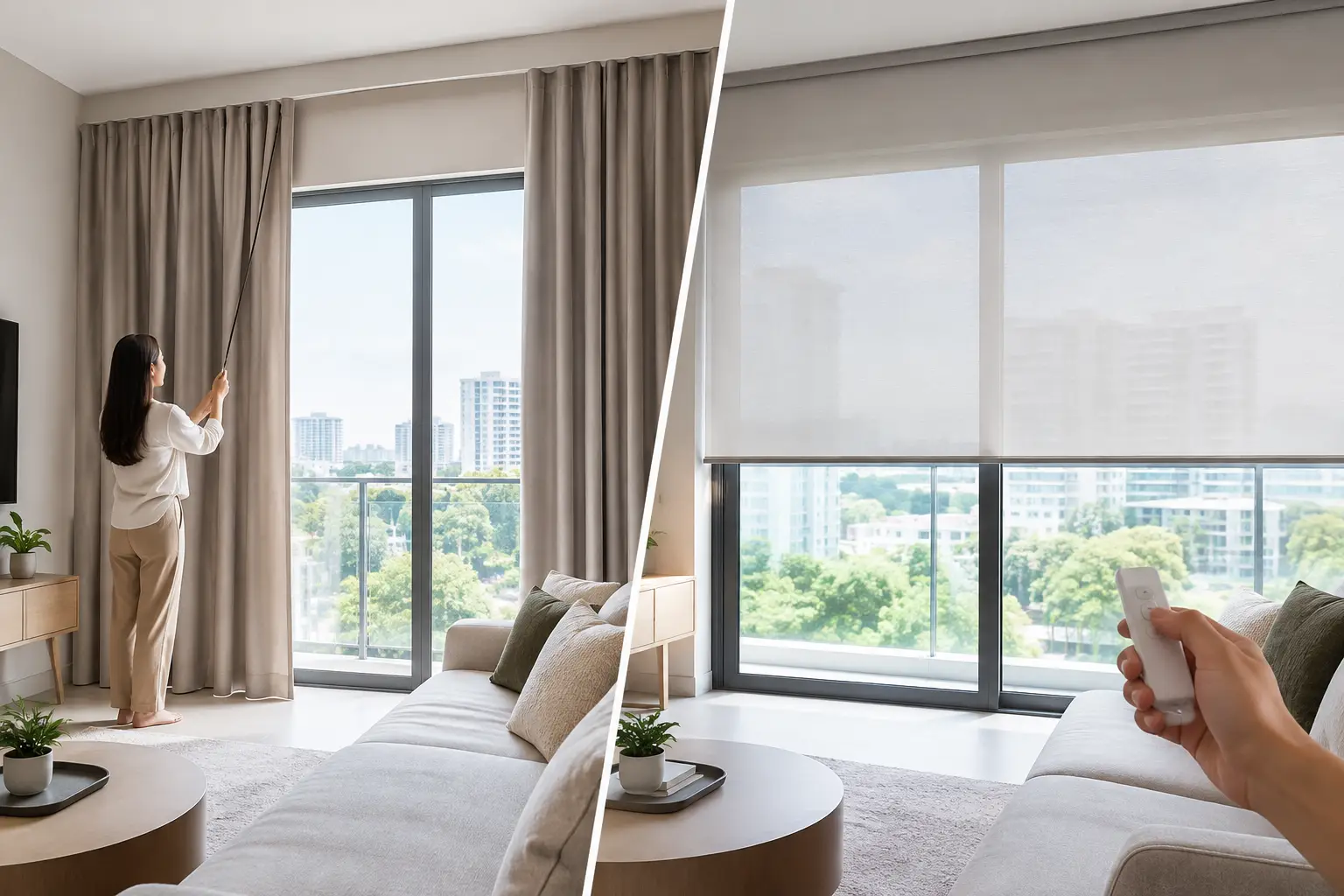

A wide living-room window can look elegant with full-height curtains, but it may be less enjoyable when you need to walk behind a sofa twice a day to open and close them. That is where the decision between manual versus motorised curtains becomes practical rather than purely decorative. The right choice depends on your window size, daily routine, curtain fabric, access to power and budget.
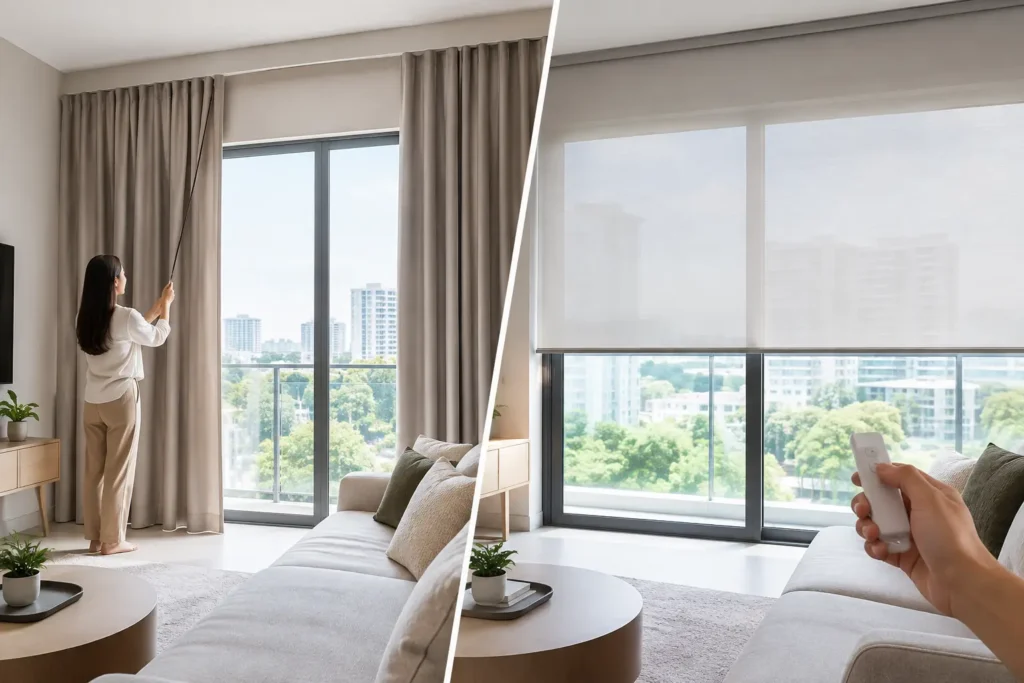
Manual curtains remain a sensible choice for many bedrooms and compact HDB or BTO flats. Motorised curtains are particularly useful for large, high or hard-to-reach windows, as well as homes where convenience, child safety or automated light control matters. Neither option is automatically better. A well-made manual curtain on the right track can operate beautifully, while a poorly planned motorised system can still be inconvenient.
You open and close manual curtains by hand, usually by drawing the leading edge or using a wand. They run on a conventional curtain track and do not require a motor, electrical point or charging arrangement.
Motorised curtains use a concealed motor to move the curtain across its track. Depending on the system and site conditions, mains power or a rechargeable battery can power the motor. Control can be by remote, wall switch, app or compatible smart-home system.
If smart-home integration is important, confirm the control method before selecting the curtain motor. In Singapore, common options include Wi-Fi, Zigbee and dry-contact integration, depending on the motor and control system. Tuya-based Wi-Fi or Zigbee setups are widely used, while some systems can connect with platforms such as Google Home or Apple Home where supported. Somfy uses its own TaHoma hub and app ecosystem, which can also integrate compatible motorised curtains and blinds with selected smart-home platforms.
The visible difference can be minimal. With ripple fold or S-fold curtains, both options can retain a clean, continuous wave when installers plan the track, fabric fullness and stack-back properly. The larger difference is in how the curtains work every day, and how much coordination is needed before installation.
Manual curtains are straightforward, dependable and usually have a lower initial cost because there is no motor or electrical work. For standard bedroom windows, study rooms and areas where the curtains are easy to reach, manual operation is often all that is needed.
They are also a good fit where homeowners prefer a simple system with fewer components. A quality aluminium track, correctly mounted and matched to the curtain weight, allows the fabric to glide smoothly. This matters more than many people realise. Heavy dim-out or blackout curtains on a light-duty track may feel difficult to pull, regardless of whether the curtain is manual or motorised.
A typical BTO bedroom window with a bed positioned nearby is easy to manage manually. So is a short run of sheers in a study, provided furniture does not block access. If you open the curtains only once in the morning and close them at night, automation may not materially change your routine.
For manual curtains, a wand is often worth considering. It reduces direct handling of sheer fabrics, which can help keep them cleaner, and prevents repeated pulling on the leading edge. This is especially useful for white or pale-coloured sheers, where hand marks may show over time.
Manual curtains require physical access along the opening edge. A deep sofa, built-in cabinet, bed frame or bay-window ledge can make even a modest curtain inconvenient to use. This is common in compact flats, where furniture placement needs to work hard.
There is also a practical limit to the curtain weight and width that feels comfortable to draw by hand. A wide span with thick blackout fabric can be managed manually, but it needs a suitable track and smooth runners. If elderly family members or young children will operate the curtain frequently, ease of handling deserves more attention than appearance alone.
Motorised curtains are most valuable when they remove a daily inconvenience. They are popular for full-height condominium windows, double-volume landed-home spaces, large living-room openings and windows behind furniture. One touch can open the sheers for daylight, close the night curtains for privacy, or draw both layers when the room is not in use.
They can also support a more consistent routine. Closing curtains before strong afternoon sun reaches a west-facing room can reduce glare on screens and make the space more comfortable. Scheduling may be useful, but it should not be the only reason to motorise. The real benefit is reliable, easy operation of curtains that would otherwise be difficult to reach or heavy to handle.
Many homes use a sheer curtain for daytime privacy and softened daylight, paired with a dim-out or blackout curtain for night-time privacy and darkness. On a wide window, operating two layers manually can become repetitive. Motorised tracks make the arrangement easier to use as intended, rather than leaving one layer permanently closed.
This is helpful in living rooms facing neighbouring blocks, where residents want daylight without feeling exposed. A sheer can remain drawn during the day while preserving some outward visibility, although privacy is reduced when interior lighting is brighter than outdoors at night. The night curtain should then be closed for proper privacy.
Motorised curtains remove the need for loose operating cords, which can be reassuring in homes with young children. The motor and track can usually be integrated neatly into a ceiling recess, pelmet or carefully planned ceiling-mounted installation.
However, a neat result depends on early planning. The track position must allow sufficient clearance from window handles, grilles, air-conditioning trunking and ceiling features. The curtain also needs space to stack when open. A motor does not reduce stack-back: thick fabric and generous fullness still occupy room at the side of the window.
Motorisation makes curtains easier to close, but it does not turn any fabric into a blackout solution. For bedrooms, the fabric, lining, track placement and light gaps all affect the result.
Blackout fabric blocks more light through the material than a dim-out fabric, but light can still enter around the sides, above the track and between two curtain panels. A ceiling-mounted track set closer to the wall can reduce top and side gaps compared with a track positioned far forward. Overlapping centre panels also help, especially on two-way opening curtains.
For a room where darkness is important, such as a nursery, shift-worker bedroom or media room, it is better to discuss the expected level of darkness honestly. Some homeowners want near-darkness; others only need reduced morning brightness and privacy. The curtain design should follow that requirement, not just the label on the fabric.
The most important question is whether you are planning the window treatment before or after renovation. Before renovation, it is easier to coordinate an electrical point, ceiling recess and track location with the interior designer or contractor. This can produce a more concealed installation, particularly for full-height curtains.
After renovation, motorisation is still possible in many homes, but an installer should assess the available options on site. Battery-powered motors may suit locations where a new power point would be disruptive, while mains-powered systems may be preferable where an electrical provision already exists. The choice depends on access, ceiling construction, curtain weight and how the homeowner expects to use the system.
Accurate measurement is essential for both options. The finished curtain width is not simply the glass width. It must account for the track length, overlap, desired return at the sides and clearance from nearby features. For motorised curtains, also consider the motor position and access for future servicing.
Match the motor to the curtain load, but give fabric selection equal attention. Lightweight sheers generally move easily and create a soft appearance. Textured linen-look fabrics, thicker dim-out materials and blackout curtains may need a stronger track and more careful pleat planning. Excessively stiff fabric can affect how neatly ripple folds form and stack.
For cleaning, regular gentle vacuuming with a suitable upholstery attachment helps remove dust from curtains. Avoid pulling fabric roughly if it catches or stops moving smoothly. With manual curtains, inspect the runners, hooks and track periodically. With motorised systems, keep the track clear and follow the operating and charging guidance provided for the selected system.
If a curtain begins to drag, do not assume the fabric is at fault. The issue may be a misaligned hook, damaged runner, overloaded track or a track installation that has shifted. Addressing small problems early can prevent unnecessary wear on the fabric and hardware.
For a standard bedroom, manual night curtains and sheers are often sufficient if access is clear. Motorisation becomes more attractive where the bed, study desk or built-in furniture makes the curtain edge difficult to reach.
In living rooms with broad glazing, motorised day and night curtains are often worth considering because the curtains are used frequently for daylight, glare and privacy. In a home office, the decision may depend on screen glare and whether sunlight changes significantly through the day. For tall stairwell or landed-property windows, motorisation can be the practical option because manual access may be unsafe or unrealistic.
When comparing manual versus motorised curtains, consider the window size, daily usage, renovation stage, power access and the level of convenience you want.
A professional consultation should start with how you live in the room, not with a motor catalogue. Sincere Interior Service can assess the window dimensions, fabric weight, track position, light-control needs and renovation constraints before recommending a manual or motorised arrangement that remains comfortable to use long after installation.
Not sure which curtain style, fabric or system suits your home? Speak with our team for personalised recommendations for your space.
GET IN TOUCH →