0

How to Measure Windows for Curtains Accurately
Learn how to measure windows curtains for a tailored fit, including track width, drop, stack-back, light gaps and practical checks for Singapore…
READ MORE →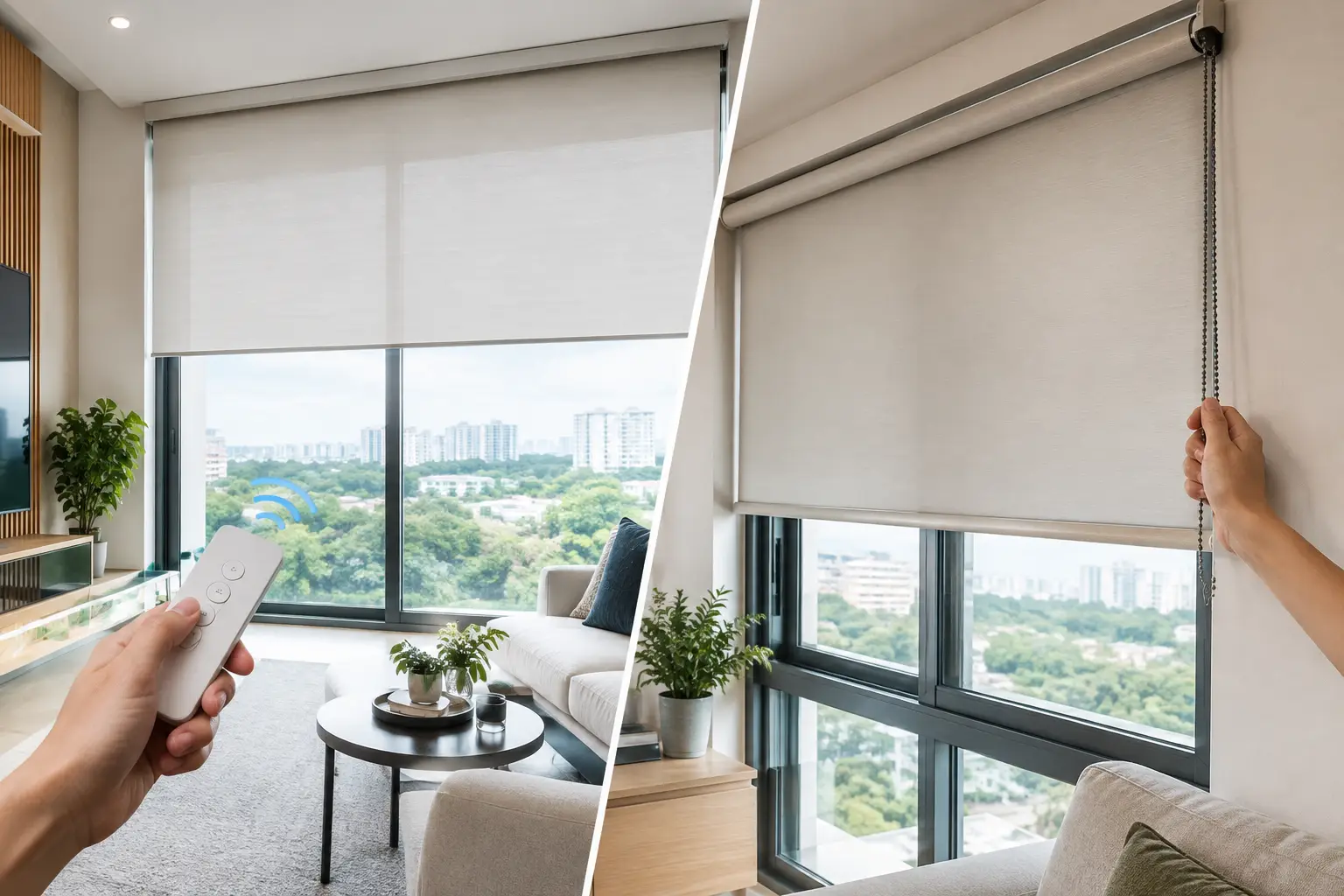

A west-facing living-room window can become uncomfortable quickly in the afternoon sun. If the blind is difficult to reach, too heavy to operate, or left open because the cord is inconvenient, the choice between motorised blinds versus manual blinds quickly becomes more than a design decision.
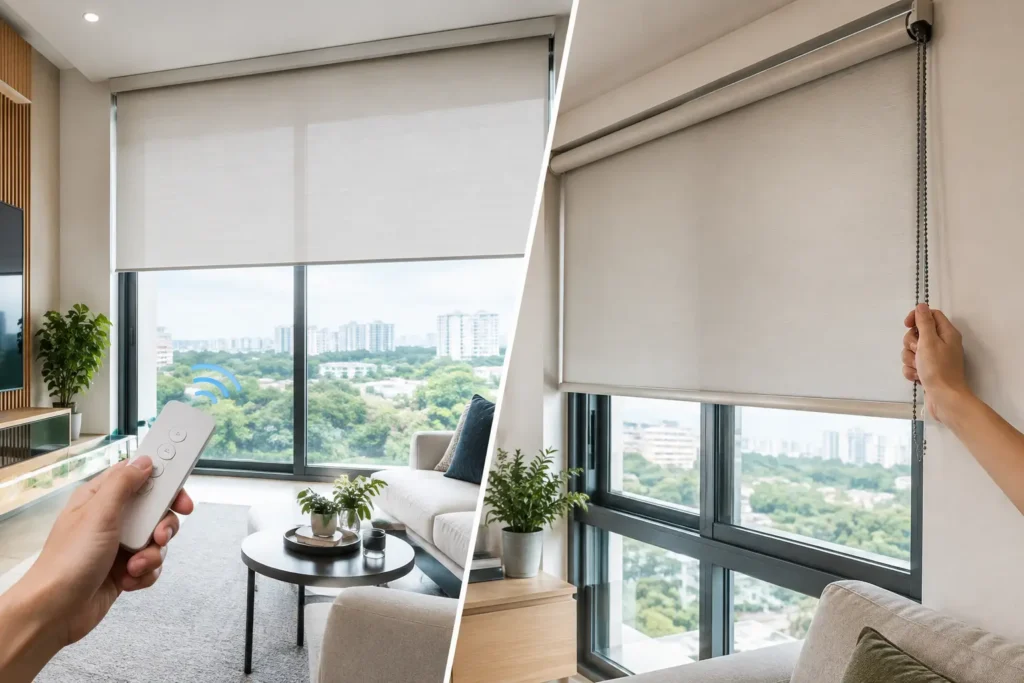
For most homes, manual blinds remain a sensible, dependable option. Motorised blinds suit large, high or frequently adjusted windows. They also help where convenience, child safety and consistent light control matter. The right answer depends on the blind type, window dimensions, room use, electrical planning and budget.
For most Singapore homes, manual blinds remain the simpler choice for standard windows that are easy to reach. Motorised blinds are more useful for wide, high or frequently adjusted windows, or where scheduled operation and easier access matter. When comparing motorised blinds versus manual blinds, consider blind size, daily use, power access and the type of light control required.
Manual blinds are operated by a chain, cord, wand or hand pull, depending on the product. Roller blinds commonly use a chain mechanism, while Venetian blinds may use a wand for tilting and a separate lifting control. They are straightforward, familiar and do not require a power source.
Motorised blinds use a concealed motor to raise, lower or tilt the blind by remote control, wall switch, app or, where compatible equipment is specified, a smart-home system. The blind itself still needs to be correctly selected and fitted. Motorisation changes how it operates; it does not compensate for an unsuitable fabric, poor measurement or light gaps around the window.
The most noticeable difference is daily effort. A manual roller blind at a standard BTO bedroom window takes little effort to use. A wide blind across a condominium living-room façade, especially one that is adjusted several times a day for heat and glare, can be much more comfortable to operate by motor.
Manual blinds are often the practical choice for smaller, easy-to-reach windows. They have a lower upfront cost because there is no motor, control system or electrical work to consider. For a study, common bedroom or secondary window where the blind is only opened in the morning and closed at night, a well-made manual system can be all that is needed.
They also suit homeowners who prefer simple controls and minimal components. A chain-operated roller blind is easy to understand, and a wand-operated Venetian blind gives immediate adjustment of slat angle for privacy and daylight. In a rental property, manual operation may be preferable where simplicity is a priority.
That said, the quality of the mechanism matters. A large blind can feel stiff or wear quickly with a light-duty chain system. Choose hardware that suits the blind size and weight. Assess the blind’s width, drop and material weight together. A blackout fabric, for example, is usually heavier than a light-filtering fabric, and very wide spans need appropriate support and operating components.
Homes with young children require extra care when using manual blind controls. Cords and chains need proper safety devices and positioning. If a window is beside a bed, cot or built-in furniture, access to a manual control may be awkward even if the window itself is not particularly large.
Motorisation is most useful where it solves a real operational problem. High windows above a staircase, double-volume areas, tall landed-home windows and large condominium glass panels are common examples. Reaching a manual control with a pole or step stool is neither convenient nor desirable for everyday use.
It is also valuable for wide blinds. A broad roller blind can become less comfortable to operate manually over time. Frequent use makes this more noticeable. A correctly specified motor provides controlled movement and avoids the temptation to tug on the fabric or bottom bar.
In rooms exposed to strong sun, programmed operation can improve everyday comfort. A programmed blind can lower before strong afternoon glare reaches the sofa or television. It can rise again later to restore the view. This can help homeowners who are often out during the day. However, plan automation around real habits rather than adding it simply because it is available.
Motorisation can also reduce the number of visible chains and cords. This gives a cleaner appearance at a bank of windows and can be helpful in compact HDB and BTO rooms where every visual detail is noticeable. It is not, however, a reason to overlook the blind’s fabric colour, openness factor or privacy performance.
Motorised blinds can use mains power or rechargeable batteries. Each has installation implications. Plan mains-powered motors during renovation where possible. This allows concealed power points and cable routes to be coordinated before carpentry and false ceilings are completed.
For a current example of blind motorisation options, Somfy Singapore lists rechargeable wire-free motors together with remote and app-based controls for interior blinds.
Battery-operated options can reduce visible wiring and suit some completed homes. Keep the motor accessible for charging and servicing. For a high window, consider how that access will work after installation. A site assessment should also check whether the proposed bracket position, window frame, pelmet and nearby cabinetry leave sufficient clearance.
Controls deserve the same attention. A remote may be enough for one or two blinds. Group control can be useful for several blinds on one façade, while smart-home integration suits households that already use compatible systems and genuinely want scheduled operation. More controls are not automatically better – they should remain simple for everyone in the household to use.
A common misunderstanding is that motorised blinds provide better blackout. The motor makes operation easier, but blackout performance depends primarily on the fabric and installation method.
A blackout roller blind blocks light through the fabric. Light can still enter at the sides, top and bottom. Recess-mounted blinds usually have small side gaps so the fabric can move freely. Face-fixed blinds can provide wider coverage. The final result still depends on the window structure, frame depth and surrounding finishes. For bedrooms that need stronger darkness, consider pairing a blackout blind with blackout curtains or suitable side channels.
For daytime privacy with softened light, consider a dim-out or sunscreen fabric instead of assuming blackout is necessary. Sunscreen roller fabrics can reduce glare while preserving an outward view during daylight hours, but they do not provide the same privacy once interior lights are on at night. In close-facing flats, this distinction is important.
Motorisation does make it easier to use the chosen blind correctly. A blind that is lowered promptly for privacy or glare control will naturally perform better in daily life than one that stays open because it is inconvenient to operate.
Not every blind behaves in the same way. Roller blinds are commonly motorised and work well for clean, broad window coverage. Korean or combi blinds alternate sheer and opaque bands, allowing light adjustment without raising the entire blind, and they can be motorised for convenient alignment.
Venetian blinds offer precise slat tilting, which is useful where occupants want to redirect daylight and maintain airflow. Their material and slat arrangement need regular dusting, and motorisation does not remove that maintenance requirement. Honeycomb blinds suit bedrooms and study rooms because of their soft appearance and compact stack. Handle and clean the fabric according to its construction.
Roman blinds create a softer, fabric-led look. Consider the folds, stack height and fabric weight before choosing them. On a shallow recess or window with casement handles, the folded stack can reduce the exposed glass area when raised. These are measurement and design issues, whether the blind is manual or motorised.
Accurate measurement is particularly important for motorised blinds. Installers must secure the brackets to a suitable surface and keep the blind level. They also need enough space for the motor, control side and fabric roll. A ceiling-mounted blind can work better when the window frame cannot support the fixing. A face-fixed blind may provide better coverage across an awkward recess.
Small installation differences become more obvious when several blinds operate together. Check roll direction, bottom-bar alignment and bracket height carefully. Professional installation helps ensure the blinds stop at appropriate positions and move evenly.
Maintenance is generally uncomplicated. Keep roller fabrics dry and dust them gently with a soft brush or vacuum attachment at low suction. Avoid pulling on the fabric or bottom bar. Venetian slats benefit from regular wiping, while fabric blinds should not be aggressively scrubbed. For motorised systems, use the controls as intended and seek advice if movement becomes uneven rather than forcing the blind.
Choose manual blinds when the windows are within easy reach, the blinds are modest in size, operation is occasional and you want the simplest, lower-cost arrangement. Choose motorised blinds when convenience will be used every day: on large, heavy or high windows; for coordinated glare control; where cords are undesirable; or where a planned smart-home routine will genuinely be useful.
A combination can be the most sensible approach. Many homeowners motorise the main living area and master-bedroom windows, then use manual blinds in secondary bedrooms or less frequently used spaces. This keeps the investment focused on the windows that affect comfort most.
Before ordering, assess the room at the time of day it is hardest to use. Look at the sun direction, neighbouring sightlines, window handles, nearby furniture, recess depth and whether the blind needs to be raised fully for ventilation or cleaning. An experienced measurement and consultation can then match the fabric, blind system and operating method to the way the room is actually lived in.
At Sincere Interior Service, we compare manual and motorised blinds around the actual window rather than convenience alone. Serving Singapore since 1976, our team assesses blind size, fabric weight, fixing conditions, power access, light-control needs and daily use before recommending a system. Professional site measurement, custom production and installation help ensure the blind remains practical long after installation.
Not sure which curtain style, fabric or system suits your home? Speak with our team for personalised recommendations for your space.
GET IN TOUCH →