0

Motorised Blinds Versus Manual Blinds for Homes
Compare motorised blinds versus manual blinds for Singapore homes, from privacy and glare control to installation, maintenance, cost and daily use needs.
READ MORE →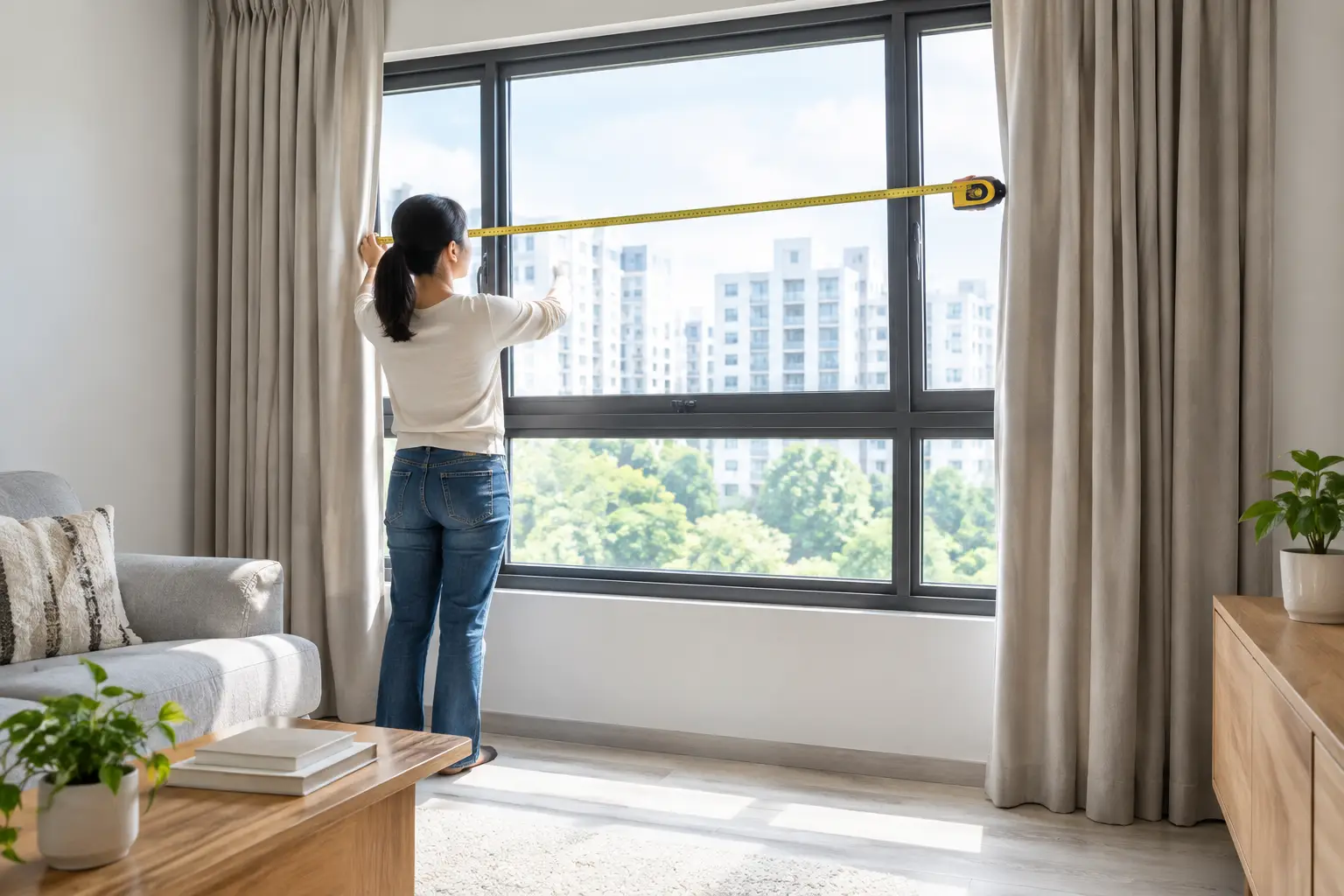

A beautifully made curtain can still look wrong when the measurements ignore the track, fabric fullness or required stack-back. If you are searching for how to measure windows for curtains, start by measuring the area the entire curtain system will cover, not only the glass.
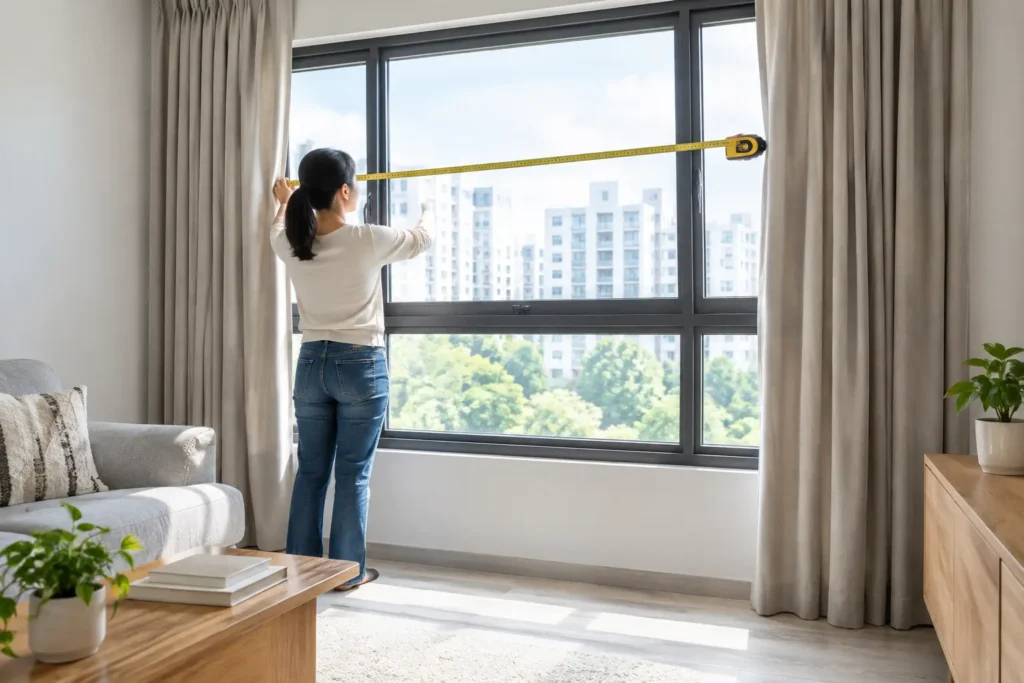
For a made-to-measure result, choose the curtain style and track position first. Then take the final measurements from that plan. This matters particularly in HDB and BTO flats. Window recesses, bulkheads and nearby air-conditioning ledges can all affect the final arrangement.
To understand how to measure windows for curtains correctly, decide the intended track position first. Measure the proposed track width, then measure the drop from the track to the finished curtain length. Record side clearance, stack-back, window obstructions and ceiling conditions rather than relying on the glass dimensions alone.
Use a steel tape measure rather than a soft sewing tape. Record each dimension in millimetres where possible. Measure twice, especially on older properties where ceilings, floors and window openings may not be perfectly level.
Before measuring, decide whether the curtains will sit inside the recess or across the wall outside it. Identify nearby obstructions before deciding the track position. Check window handles, grilles, pelmets, ceiling fans, cabinets and air-conditioning units.
Take a wide photo of each window, including the surrounding wall and ceiling. This gives the curtain specialist useful context before the site visit. It provides context that dimensions alone cannot show.
For curtains, the width that matters is normally the track width, not the width of the window. Measure the full horizontal distance from one end of the proposed track to the other.
Where wall space permits, extend the track beyond each side of the window. This improves coverage when the curtains are closed. It also allows more glass to remain visible when they are open. The exact extension depends on available wall space, the window layout and the curtain heading. There is no useful one-size-fits-all allowance.
A bedroom window beside a built-in wardrobe may have very little space for track extension on one side. In this case, the curtain stack may overlap part of the glass when open. A compact blind may work better where side space is limited. It can also complement curtains when homeowners want both privacy and fabric softness.
Do not treat an L-shaped or bay window as one straight opening. Measure each run separately and note where the tracks meet. A professional installer also checks how the treatment should turn the corner. Options may include a bent track, separate tracks or a combination of curtains and blinds.
For more complex bay or angled layouts, Forest Group also provides curtain-track measuring tools that calculate and check the required dimensions and angles.
For wide condominium living room windows, consider where the curtain panels will stack. Very wide curtains can create substantial stack-back, especially when using heavier blackout fabric. Splitting the track into more panels can make daily operation easier. However, it also changes the appearance and opening positions.
The drop is the vertical measurement from the underside of the installed track to the desired curtain finish. Measure at the left, centre and right of the track position. If the floor or ceiling is uneven, record the variation at each point. The installer can then determine the most suitable finished drop.
For full-length curtains, most homeowners choose a finish that sits close to the floor without dragging. This gives a neat, tailored look and avoids fabric collecting dust. A slight break on the floor creates a more relaxed look. However, it is less practical with pets, young children or frequent floor cleaning.
If furniture, a ledge or a built-in bench sits below the window, decide where the curtain should finish. It may stop above the obstruction or continue to the floor. Curtains ending at a sill need particularly accurate measurement because even a small variation is noticeable. Floor-length curtains often look more balanced in bedrooms and living areas, while a short blind or sill-length treatment can be practical in kitchens.
Different curtain styles hang differently beneath the track.
Ripple fold and S-fold curtains create consistent waves beneath the track. Pleated headings sit differently because their hooks and carrier systems vary.
This is why measuring from an existing curtain rod or from the top of a window frame can be misleading. For a new ceiling-mounted track, measure the final drop from the planned installation line. If the renovation includes a pelmet or false ceiling, confirm its dimensions before ordering the curtains.
Blackout fabric blocks light through the material itself. It cannot eliminate every gap around the curtain edges. Light can enter above the track, below the hem and at the sides, especially where the curtain must clear a window handle or grille.
For bedrooms, measure how much coverage can extend past the window and whether the track can sit close to the ceiling. A ceiling-mounted track can improve room-darkening when the curtains extend beyond the window sides. A short track above the frame usually leaves more edge light. A day-and-night arrangement offers more flexibility when homeowners need both daytime privacy and night-time darkness. It pairs sheer curtains with a separate blackout layer.
A blind may be more suitable where side clearance is limited. However, blinds also have edge gaps, and the amount depends on the product, mounting method and window shape. Roller blinds offer a clean, compact appearance; honeycomb blinds can suit windows where a softer insulated structure is preferred; Venetian blinds offer adjustable light direction but require more regular cleaning.
A common measuring mistake is to check only how curtains look when closed. The open position is equally important. The stack-back is the amount of space occupied by curtains when gathered at one or both sides of the track.
Sheer fabric usually creates a lighter stack than lined or blackout curtains. Fuller curtains require more side space than compact blinds. Ripple fold curtains create orderly, even waves. Allow enough stack-back beside sliding doors and full-height windows.
Check the space around the open curtains. They should not block balcony doors, light switches, cabinets or the usable opening of a casement window. In compact BTO bedrooms, this check often determines whether curtains, blinds or a combined treatment makes better sense.
Accurate measurements only help when installers can secure the proposed track properly.Concrete ceilings, false ceilings and boxed-up areas require different fixing methods. False ceilings may need additional support, while wall-mounted tracks require enough solid wall area and window clearance.
Motorised curtains need planning at this stage too.The motor needs space at one end of the track. Plan the power point or agreed power solution before renovation work is completed. For high or difficult-to-reach windows, motorisation can be very convenient, but the final track layout must allow for smooth movement and future access.
If you are replacing existing curtains, do not assume the old track is correctly positioned or suitable for the new fabric. A heavier lined curtain, a wider span or a different heading may require a new track or more support brackets.
Home measurements are useful for early discussions and preliminary quotations. A professional should confirm the final production measurements on site after the curtain, track and installation position are decided.
Professional measurement is particularly valuable for full-height glazing, curved windows, double-volume spaces, recessed tracks, motorised systems and tight installation areas. An experienced measurer checks levels, mounting surfaces, fabric clearance and operational details that are easy to miss with a tape measure alone.
At Sincere Interior Service, site measurement involves more than recording width and drop. Serving Singapore since 1976, our team checks track position, mounting surfaces, stack-back, fabric clearance, light gaps and how the window operates before production begins. Professional site measurement helps ensure that the finished curtains fit the actual opening and remain practical for everyday use.
Not sure which curtain style, fabric or system suits your home? Speak with our team for personalised recommendations for your space.
GET IN TOUCH →