


 0

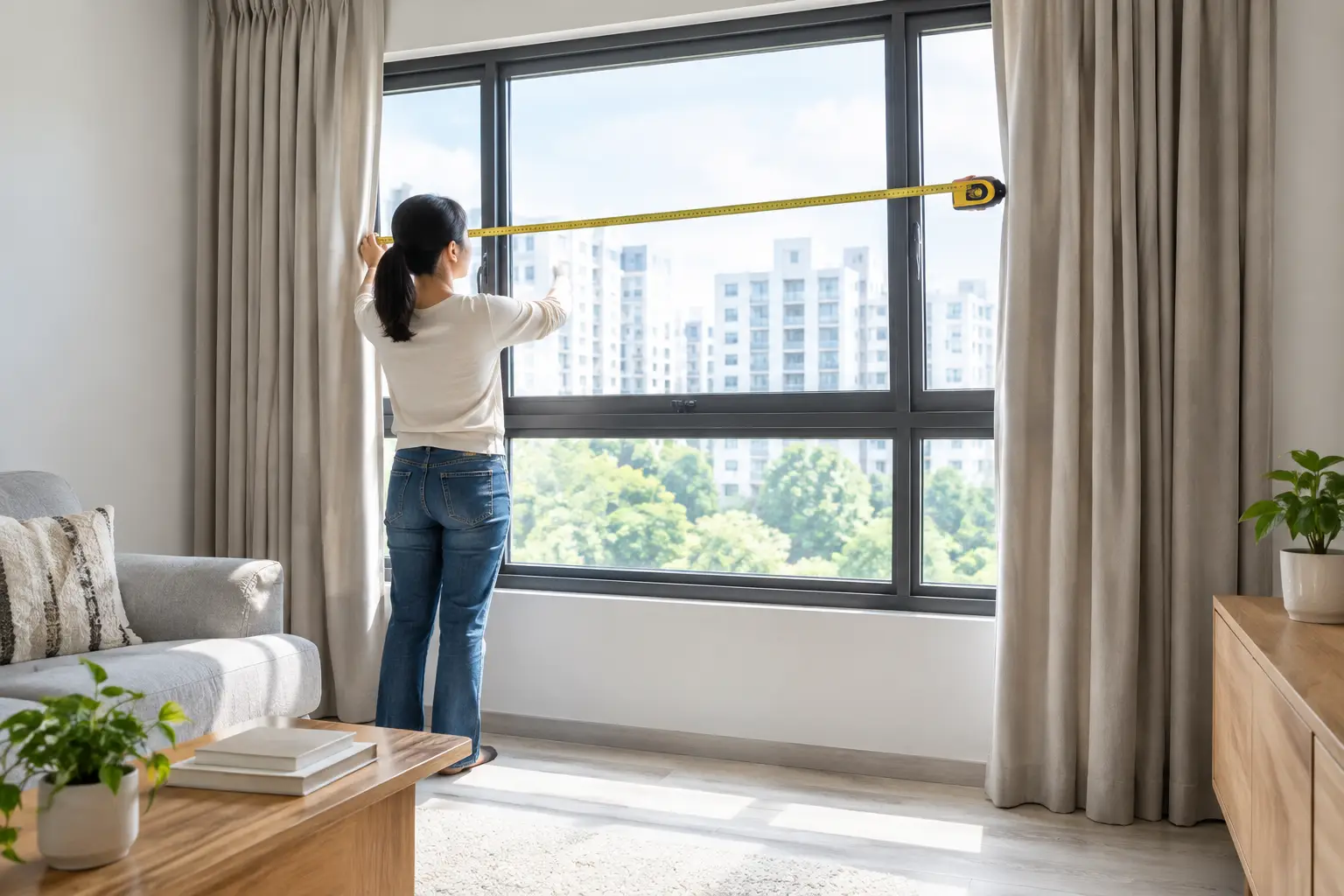
A beautifully made curtain can still look wrong when the measurements ignore the track, fabric fullness or required stack-back. If you are searching for how to measure windows for curtains, start by measuring the area the entire curtain system will cover, not only the glass.
For a made-to-measure result, choose the curtain style and track position first. Then take the final measurements from that plan. This matters particularly in HDB and BTO flats. Window recesses, bulkheads and nearby air-conditioning ledges can all affect the final arrangement.
To understand how to measure windows for curtains correctly, decide the intended track position first. Measure the proposed track width, then measure the drop from the track to the finished curtain length. Record side clearance, stack-back, window obstructions and ceiling conditions rather than relying on the glass dimensions alone.
These factors work together, which is why two windows of similar size can still receive different quotations.
A made-to-measure quotation uses the actual site measurement rather than the glass size alone. The track may need to extend beyond the window so the curtains can draw clear of the glass. The height may run from ceiling to floor, above a pelmet, or around a window ledge. These decisions change both fabric quantity and the track required.
A professional measurement is particularly useful in newer BTO flats and condominiums, where ceiling details, bulkheads, sprinkler positions, sliding doors and limited wall space can influence the installation method. In landed homes, very wide or tall openings may need heavier-duty tracks, joins planned carefully, or motorised operation to keep the curtains easy to use.
What you need before measuring curtains
Use a steel tape measure rather than a soft sewing tape. Record each dimension in millimetres where possible. Measure twice, especially on older properties where ceilings, floors and window openings may not be perfectly level. Before measuring, decide whether the curtains will sit inside the recess or across the wall outside it. Identify nearby obstructions before deciding the track position. Check window handles, grilles, pelmets, ceiling fans, cabinets and air-conditioning units. Take a wide photo of each window, including the surrounding wall and ceiling. This gives the curtain specialist useful context before the site visit. It provides context that dimensions alone cannot show.How to measure windows for curtains: width
For curtains, the width that matters is normally the track width, not the width of the window. Measure the full horizontal distance from one end of the proposed track to the other. Where wall space permits, extend the track beyond each side of the window. This improves coverage when the curtains are closed. It also allows more glass to remain visible when they are open. The exact extension depends on available wall space, the window layout and the curtain heading. There is no useful one-size-fits-all allowance. A bedroom window beside a built-in wardrobe may have very little space for track extension on one side. In this case, the curtain stack may overlap part of the glass when open. A compact blind may work better where side space is limited. It can also complement curtains when homeowners want both privacy and fabric softness.Measure each section of a bay or corner window
Do not treat an L-shaped or bay window as one straight opening. Measure each run separately and note where the tracks meet. A professional installer also checks how the treatment should turn the corner. Options may include a bent track, separate tracks or a combination of curtains and blinds. For more complex bay or angled layouts, Forest Group also provides curtain-track measuring tools that calculate and check the required dimensions and angles. For wide condominium living room windows, consider where the curtain panels will stack. Very wide curtains can create substantial stack-back, especially when using heavier blackout fabric. Splitting the track into more panels can make daily operation easier. However, it also changes the appearance and opening positions.How to Measure Windows for Curtains: Drop
The drop is the vertical measurement from the underside of the installed track to the desired curtain finish. Measure at the left, centre and right of the track position. If the floor or ceiling is uneven, record the variation at each point. The installer can then determine the most suitable finished drop. For full-length curtains, most homeowners choose a finish that sits close to the floor without dragging. This gives a neat, tailored look and avoids fabric collecting dust. A slight break on the floor creates a more relaxed look. However, it is less practical with pets, young children or frequent floor cleaning. If furniture, a ledge or a built-in bench sits below the window, decide where the curtain should finish. It may stop above the obstruction or continue to the floor. Curtains ending at a sill need particularly accurate measurement because even a small variation is noticeable. Floor-length curtains often look more balanced in bedrooms and living areas, while a short blind or sill-length treatment can be practical in kitchens.Allow for the track and heading style
Different curtain styles hang differently beneath the track. Ripple fold and S-fold curtains create consistent waves beneath the track. Pleated headings sit differently because their hooks and carrier systems vary. This is why measuring from an existing curtain rod or from the top of a window frame can be misleading. For a new ceiling-mounted track, measure the final drop from the planned installation line. If the renovation includes a pelmet or false ceiling, confirm its dimensions before ordering the curtains.Plan for light gaps and blackout expectations
Blackout fabric blocks light through the material itself. It cannot eliminate every gap around the curtain edges. Light can enter above the track, below the hem and at the sides, especially where the curtain must clear a window handle or grille. For bedrooms, measure how much coverage can extend past the window and whether the track can sit close to the ceiling. A ceiling-mounted track can improve room-darkening when the curtains extend beyond the window sides. A short track above the frame usually leaves more edge light. A day-and-night arrangement offers more flexibility when homeowners need both daytime privacy and night-time darkness. It pairs sheer curtains with a separate blackout layer. A blind may be more suitable where side clearance is limited. However, blinds also have edge gaps, and the amount depends on the product, mounting method and window shape. Roller blinds offer a clean, compact appearance; honeycomb blinds can suit windows where a softer insulated structure is preferred; Venetian blinds offer adjustable light direction but require more regular cleaning.Check the open position and stack-back
A common measuring mistake is to check only how curtains look when closed. The open position is equally important. The stack-back is the amount of space occupied by curtains when gathered at one or both sides of the track. Sheer fabric usually creates a lighter stack than lined or blackout curtains. Fuller curtains require more side space than compact blinds. Ripple fold curtains create orderly, even waves. Allow enough stack-back beside sliding doors and full-height windows. Check the space around the open curtains. They should not block balcony doors, light switches, cabinets or the usable opening of a casement window. In compact BTO bedrooms, this check often determines whether curtains, blinds or a combined treatment makes better sense.Consider track location and installation constraints
Accurate measurements only help when installers can secure the proposed track properly.Concrete ceilings, false ceilings and boxed-up areas require different fixing methods. False ceilings may need additional support, while wall-mounted tracks require enough solid wall area and window clearance. Motorised curtains need planning at this stage too.The motor needs space at one end of the track. Plan the power point or agreed power solution before renovation work is completed. For high or difficult-to-reach windows, motorisation can be very convenient, but the final track layout must allow for smooth movement and future access. If you are replacing existing curtains, do not assume the old track is correctly positioned or suitable for the new fabric. A heavier lined curtain, a wider span or a different heading may require a new track or more support brackets.How to Measure Windows for Curtains Before a Professional Visit
Home measurements are useful for early discussions and preliminary quotations. A professional should confirm the final production measurements on site after the curtain, track and installation position are decided. Professional measurement is particularly valuable for full-height glazing, curved windows, double-volume spaces, recessed tracks, motorised systems and tight installation areas. An experienced measurer checks levels, mounting surfaces, fabric clearance and operational details that are easy to miss with a tape measure alone. At Sincere Interior Service, site measurement involves more than recording width and drop. Serving Singapore since 1976, our team checks track position, mounting surfaces, stack-back, fabric clearance, light gaps and how the window operates before production begins. Professional site measurement helps ensure that the finished curtains fit the actual opening and remain practical for everyday use.A west-facing living room window can turn a pleasant afternoon into a time when everyone avoids the sofa. The right blind should manage glare and privacy without making the room feel closed in. When comparing roller blinds versus Roman blinds, the difference is straightforward. Roller blinds are neat, practical and compact. Roman blinds add fabric softness and a more decorative finish. Neither is automatically the right choice. The better option depends on the room, window size, sun exposure and privacy needs. Also consider how much day-to-day maintenance you are comfortable with. For Singapore homes, roller blinds usually suit rooms where compactness, simple operation and easier cleaning matter most. Roman blinds suit spaces where fabric texture and a softer, more furnished look are the priority. When comparing roller blinds versus Roman blinds, window size, privacy, blackout needs and maintenance should guide the choice.Roller blinds versus Roman blinds at a glance
Roller blinds use a single flat panel of fabric that rolls around a tube at the top of the window. When you raise the blind, the fabric forms a small, tidy roll rather than a large stack. This makes them particularly suitable for compact HDB and BTO rooms, windows near cabinets, and spaces where a clean-lined appearance is preferred. Roman blinds use fabric that forms horizontal folds as the blind rises. The blind sits flatter when lowered and gathers into a visible fabric stack when raised. Their tailored folds give bedrooms, dining areas and living rooms a warmer, more furnished look. In practical terms, roller blinds usually win for simple operation, a minimal profile and easier cleaning. Roman blinds often suit homeowners who place greater value on fabric texture, colour and a softer decorative effect.Roller Blinds Versus Roman Blinds for Light Control
Both blind types are available in dim-out or blackout materials. However, fabric alone does not determine how dark the room becomes. Light can still enter around the sides, above the blind and sometimes below it. This is particularly noticeable in bedrooms with strong morning sunlight. A roller blind can sit relatively close to the window or wall, depending on the mounting method. With accurate measurement and suitable brackets, this can reduce side light gaps. However, it will not usually give the same room-darkening result as a well-designed blackout curtain system that overlaps the wall and track. You can also add blackout lining to Roman blinds. The face fabric and lining allow more design flexibility, which is useful when a bedroom needs darkness but you do not want the look of technical blind fabric. Because Roman blinds have stitched sections and folds, small points of light may remain more visible than on a plain roller blind, especially with light-coloured fabrics. For a study or living room, sunscreen roller blinds are often a sensible choice. They reduce harsh glare while retaining some outward view during the day. At night, however, sunscreen fabric does not provide full privacy when interior lights are on. A Roman blind in a lined fabric offers more privacy, but it will also block the view and more daylight when lowered.Appearance and fabric choices
Choose roller blinds when the window furnishing should sit quietly in the room. They suit contemporary BTO flats, condominium units and offices, especially where cabinetry, feature walls or a restrained colour scheme are already doing the visual work. Available fabrics include sunscreen, translucent, dim-out and blackout options, so a simple appearance does not mean limited function. Choose Roman blinds when the blind itself should contribute to the room’s character. Linen-look, textured weaves and patterned fabrics can soften a plain wall or connect the window treatment with cushions, upholstery or a bedhead. The folds make the fabric more visible, so fabric selection deserves careful thought. A heavy or overly bulky material may create a larger stack when raised and can look disproportionate on a narrow window. Roman blinds are often attractive in a master bedroom, nursery, dining room or a landed home study where the window is a focal point. They can also work well on smaller windows that would look underdressed with curtains alone. On very wide glazing, however, multiple Roman blind sections may be needed. The divisions can be visually noticeable, so roller blinds or curtains may provide a cleaner result.Space, window shape and installation constraints
The space above the window is one of the first details to check. Roman blinds need sufficient height for their headrail and fabric stack. If the window sits close to a ceiling bulkhead, air-conditioning trunking or a pelmet, check the available clearance. Insufficient space can prevent the blind from raising fully. Roller blinds need less top space and are generally easier to fit within a window recess. Recess fitting can look neat, but it requires a suitably deep and unobstructed recess. Check window handles, grilles and projecting frames so the fabric can lower smoothly. For HDB and condominium windows, it is also worth considering access to casement panels. Raise the blind before opening any window panel positioned behind it. Plan the control position, blind width and divider bars around daily ventilation habits. Installers can mount Roman blinds outside the recess to cover more of the frame and reduce light gaps. This needs wall space on both sides and above the window. A professional site measurement helps identify whether the wall surface, window reveal and surrounding fixtures can support the selected system securely.Operation, motorisation and safety
Both roller and Roman blinds can use manual chain or motorised operation. The suitable system depends on blind size, weight and installation conditions. Roller blinds suit motorisation particularly well because the mechanism is compact and the movement is simple. They are useful for high windows, broad living room glazing and rooms where blinds are adjusted frequently to manage heat and glare. Motorised Roman blinds can be a good option too, particularly for hard-to-reach windows. However, fabric weight and blind dimensions matter more. A heavier lined Roman blind needs a motor and mechanism that can lift the fabric evenly and reliably. For homes with young children, keep accessible blind chains secured and out of reach. Singapore’s Consumer Product Safety Office recommends cordless window coverings where possible and advises using tension devices or cleats when cords are present. During consultation, also consider the control position, furniture placement and whether motorisation would make everyday use safer and easier.Cleaning, durability and daily use
Roller blinds are usually the lower-maintenance choice. You can dust many roller-blind fabrics with a soft brush attachment or wipe them carefully with a lightly damp cloth. Always follow the fabric supplier’s care guidance. Their flat surface collects less dust than folded fabric, which can be helpful in busy households and commercial settings. Roman blinds need more careful upkeep because dust can settle in the folds. Regular light vacuuming is advisable. Some Roman-blind fabrics and linings require specialist cleaning rather than casual washing. Consider this before choosing pale or heavily textured fabric for a kitchen-adjacent dining area or a room used by children. Durability also relates to use. A roller blind is often the more practical choice for windows opened and closed throughout the day. A well-made Roman blind can also be durable. However, its extra fabric and lifting components benefit from gentler operation and sensible fabric selection.Roller Blinds Versus Roman Blinds by Room
For kitchens, service yards and workspaces, roller blinds are usually more practical because they are compact and easier to maintain. In living rooms, sunscreen roller blinds suit homes that need daytime glare control without losing all natural light. Pairing them with curtains can provide night privacy and a more complete finish. For bedrooms, the decision depends on priorities. Roller blackout blinds offer a crisp, uncluttered look and straightforward use. Lined Roman blinds suit those who want a softer fabric feature, although homeowners seeking the darkest possible room should consider blackout curtains as part of the solution. For a nursery or guest room, Roman blinds can add warmth without taking up floor space. For tall or difficult-to-reach windows, motorised roller blinds are often the more convenient choice. Commercial spaces often favour roller blinds for their clean appearance, uniformity and easier maintenance.Make the choice after measuring, not before
Photographs can make both styles look equally suitable, but actual window conditions often change the decision. Dimensions, sun direction, handles, grilles, ceiling details and furniture placement all affect performance. View fabric samples at the actual window because daylight can change their colour, openness and privacy level considerably. Serving Singapore since 1976, Sincere Interior Service approaches this choice as a practical fit rather than a style contest. During a professional site consultation, our team assesses window dimensions, sun exposure, likely light gaps, stack-back, blind fabric and operating method. We then recommend the option that will remain practical to operate, clean and live with after installation.A west-facing living room can be bright and uncomfortable long before the afternoon is over. Window automation lets curtains or blinds respond to daily routines automatically. This removes the need to cross the room, reach over furniture or struggle with a high window. For many homeowners, the real value is not simply a remote control. It is easier light management, better privacy at the right time and more practical use of large window furnishings. Motorised curtains and blinds can suit HDB and BTO flats, condominiums, landed homes and commercial spaces. The best arrangement depends on the window, furnishing type and how the room is used. Assess the site before installation rather than adding automation as an afterthought. Window automation is most useful for wide, high or frequently adjusted curtains and blinds. In Singapore homes, motorised systems can manage glare, privacy and daylight through a wall switch, remote, app or compatible smart-home control. The right setup depends on the window furnishing, power access and how often it will operate.What window automation can do
Window automation uses a motor to open, close, raise or lower a curtain or blind. Homeowners can operate the system by wall switch, handheld remote, mobile app or compatible smart-home control. The available options depend on the selected motor and controller. Some setups also support schedules. For example, bedroom curtains can open in the morning while living-room blinds lower during strong afternoon sun. For a family, this can make day and night curtains easier to use as intended. The sheer layer can stay closed for daytime privacy while admitting softened daylight. Later, the night curtain can close for stronger privacy. In a home office, automation can lower a roller blind when glare reaches a computer screen. Automation does not change the light-blocking properties of a fabric or blind material. A motorised blackout curtain can still have light gaps at the top, sides or centre overlap. Good track positioning and curtain design help reduce them. Similarly, a sunscreen roller blind reduces glare but does not provide the privacy or darkness of a blackout solution at night.Plan Window Automation Around the Window and Room
Start with practical questions about the window and how the room is used. Is the primary concern heat and glare, daytime privacy, bedroom darkness, convenience or the need to operate a very wide window? The answer may lead to a different product. Curtains suit bedrooms and living areas where homeowners want softness, fuller coverage and a layered look. A motorised day-and-night arrangement provides flexible control. It also needs enough depth for double tracks and sufficient wall space for stack-back. When curtains are open, the fabric gathers at the sides. On a compact BTO wall, the opened curtain can cover part of the glass. Include this stack-back during measurement. Motorised roller blinds suit study rooms, kitchens, balconies and compact windows. They sit close to the glass and avoid bulky curtain stack-back. They sit close to the window and can be specified in different materials, from light-filtering fabrics to dim-out or blackout fabrics. However, roller blinds generally have more perimeter light gaps than a well-designed curtain system, especially where the blind is fitted inside a recess. For wide condominium glazing or tall landed-home windows, check motor capacity, track length and fabric weight carefully. A heavier blackout curtain requires a suitable motor and track, not merely an automated version of a light sheer track. Correct support placement also helps the track run smoothly and prevents sagging over time.Choosing between automated curtains and blinds
There is no single answer because curtains and blinds manage light differently. The choice should reflect your daily use rather than appearance alone.Motorised curtains for layered privacy and softer coverage
Motorised curtains work particularly well where you want a sheer during the day and a heavier fabric at night. Sheer curtains soften harsh sunlight and reduce exposure to neighbouring blocks. They do not provide complete privacy after dark when indoor lights are on. Pairing them with a night curtain gives the room a more useful day-to-night arrangement. For bedrooms, blackout fabric is commonly requested. It can significantly darken a room, yet expectations should be realistic. Light can enter around the edges and through the gap between curtain panels. Extending the track beyond the window and mounting it close to the ceiling can improve room-darkening. Suitable panel overlap can also reduce centre gaps. A pelmet or recess can also reduce top light leakage, depending on the existing ceiling detail. Ripple fold and S-fold curtains create consistent waves and look neat on long tracks. Plan stack-back carefully because heading style and fullness affect the space required.Motorised blinds for a clean, compact solution
Motorised blinds suit rooms where a neat profile and precise positioning matter more than full drapery coverage. Roller blinds offer simple operation and suit many contemporary interiors. Venetian blinds provide adjustable slats for directing daylight, but their individual slats and mechanisms need more regular dusting. Honeycomb blinds offer a softer, structured appearance. Handle the fabric cells carefully so they retain their shape. Korean or combi blinds use alternating sheer and opaque bands for adjustable filtered light. They are useful in living rooms and studies, but they are not the same as a blackout curtain system. The layered bands may still allow light through, and night-time privacy depends on the position of the opaque sections.Plan Power Early for Window Automation
Plan window automation during renovation, before contractors complete false ceilings, carpentry and paintwork. A concealed power point near the track or blind can create a cleaner finish and reduce visible cables. Coordinate the power point with the curtain track position, especially where pelmets, ceiling recesses or air-conditioning trunking affect access. Battery-powered options can suit completed homes where new wiring would be disruptive. They avoid extensive electrical work but require periodic charging or battery replacement. This is a reasonable trade-off for a single study blind or an existing bedroom, whereas hardwired power may be more convenient for several large curtains used every day. For smart-home control, check compatibility before choosing the motor. If the system uses Zigbee, confirm that the motor and hub belong to compatible ecosystems. The Connectivity Standards Alliance describes Zigbee as an interoperable networking standard used across connected-home devices. Confirm the intended ecosystem, controls and routines at the outset. Do not assume every app, voice assistant or hub will work together. A dependable wall switch or remote is also worth retaining, particularly for family members and guests who prefer straightforward controls.Installation details that affect daily use
Accurate measurement is central to a good automated setup. The installer should assess the ceiling or wall surface, window recess, nearby cupboards and air-conditioning units. They should also confirm that the window can still open comfortably. Beam details, uneven surfaces or weak fixing points can prevent the installer from mounting the track where expected. Select the curtain track for the fabric weight and curtain heading. A quality motor cannot compensate for a poorly supported track, an overly heavy fabric choice or curtains that catch on an obstruction. For blinds, the width, drop and mounting method affect how evenly the fabric rolls and where light gaps will appear. Child safety is another practical advantage. Motorised systems reduce the need for accessible operating chains and cords. Place controls where they are easy to reach. Show homeowners how to operate or reset the system manually when required.Maintenance and long-term expectations
Automated window furnishings need routine care, although they should not be difficult to maintain. Curtains benefit from regular vacuuming with a soft brush attachment and occasional professional cleaning based on the fabric care instructions. Avoid pulling the fabric by hand when it is motorised. Use the designated control so the curtain continues to travel evenly. Dust blinds regularly, especially in kitchens or homes near busy roads where fine particles can accumulate. Do not spray water or cleaning products directly onto motors, tracks or control components. If a curtain moves unevenly, a blind stops partway or a track sounds unusual, stop forcing the system. Arrange an inspection instead. A customised system is easier to support when the curtain or blind, motor, track and installation are planned together. Serving Singapore since 1976, Sincere Interior Service assesses window dimensions, fabric or blind weight, stack-back, fixing conditions, power access and control preferences before recommending a system. Our team provides professional site measurement, Singapore-based custom production, installation, post-installation support and a 12-month warranty.Is window automation worth adding?
Window automation is most worthwhile when it removes a regular inconvenience. Examples include wide curtains that are tiring to draw, high windows that are hard to reach, strong daily glare or frequent privacy adjustments. It may be less necessary for a small, rarely used window with a light blind that is easy to operate by hand. Before deciding, consider how often the furnishing will move, who will use it and what result you expect. A proper site discussion can clarify the available fixing points, stack-back space, wiring options and likely light gaps. That is the practical route to a window furnishing that remains easy to live with long after the renovation is finished.Motorised curtain systems are most useful for wide, heavy, high or frequently operated curtains. A reliable setup depends on more than the motor: track quality, curtain weight, heading style, stack-back, power access and controls must work together. For Singapore homes, motorisation can be especially practical for full-height condominium glazing, wide HDB or BTO living-room windows and day-and-night curtains. This guide explains what to review before choosing a motorised curtain system, from track design and fabric load to controls, installation and long-term maintenance.What to Review in Motorised Curtain Systems
A good review should consider the motor, but it should not stop there. The motor is only one part of a working system. The track, brackets, curtain heading, fabric weight, window width and available stack-back space all affect the result. A well-fitted system should open and close at an even pace without jerking or pulling the curtain fabric out of shape. The curtains should meet correctly at the centre for a centre-opening arrangement, or return fully to one side for a one-way draw. If the curtain does not sit properly when open, it may block part of the glass and reduce the view or daylight entering the room. Noise also matters more than many homeowners expect. Some operational sound is normal, especially in a quiet bedroom at night. However, the movement should feel controlled rather than strained. A heavy blackout curtain on a long track needs an appropriate motor and properly supported track. Choosing a motor based only on price can lead to slower operation or unnecessary wear over time. Reviews should also distinguish between convenience and necessity. For a narrow kitchen window or a rarely used study blind, manual operation may be the more sensible option. Motorisation is most useful where curtains are large, high, frequently adjusted, difficult to reach or part of a regular privacy and sunlight-control routine.Track Quality in Motorised Curtain Systems
The track determines how smoothly a motorised curtain travels. This matters especially for ripple fold and S-fold curtains, which rely on consistent spacing to form even waves. Poor track, carrier or spacing choices can create uneven folds and bulky stack-back. Motor and track selection should also reflect the curtain’s weight, width, opening style and available power supply. Somfy Singapore highlights these factors in its curtain-system selection checklist. For a wide living-room frontage, installers should secure the track properly along its full length. This is not simply a matter of putting up more brackets. The installer needs to assess the ceiling or wall condition, the pelmet design, whether there are concealed services, and whether the track must clear window handles, air-conditioning trunking or nearby cabinetry. A recessed ceiling pocket can give a clean, hotel-style appearance, but it needs early planning during renovation. In an existing flat, surface-mounted tracks are often more practical. Accurate installation can still produce a neat result, especially with a suitable pelmet or concealed ceiling detail.Centre Opening or One-Way Draw?
Centre-opening curtains create a balanced look and are common on symmetrical windows. One-way draw can be more suitable where a balcony door is on one side, where furniture limits stack-back space, or where only one side of the window is regularly accessed. This decision affects more than appearance. A one-way curtain needs sufficient clear wall space at its stacking side. If there is no room for it, the open curtain will cover part of the window. During a site measurement, it is worth checking where the curtain will sit when fully open, not only how it looks when closed.Fabric Weight, Fullness and Blackout Performance
Motorised tracks work with sheer, dim-out and blackout curtains, but each fabric behaves differently. A lightweight sheer generally gathers easily and produces a softer stack. A lined blackout curtain is heavier and bulkier, particularly when made with generous fullness for a richer appearance. Homeowners often choose blackout curtains for bedrooms exposed to early sunlight. Yet homeowners should understand that blackout fabric alone does not remove every trace of light. Light can still enter around the sides, above the track, between two curtain panels, and at the bottom. A ceiling-mounted track with adequate overlap can reduce these gaps. However, assess the actual site before promising complete darkness. For many bedrooms, a day-and-night curtain arrangement works well: a sheer curtain for daytime privacy and softened daylight, with a separate blackout or dim-out layer for evening use. Homeowners can motorise both layers, although this requires additional track and control planning. It is most suitable when the household will genuinely use both layers regularly. In rooms facing strong afternoon sun, fabric choice should also consider glare and heat. A sheer can cut glare while keeping the room bright, but it will not provide the same room-darkening effect as a blackout curtain. A dim-out fabric sits between the two, offering more light reduction while retaining a softer feel than a full blackout lining.Controls: Remote, Wall Switch or Smart Home?
Most homeowners find a remote control straightforward, particularly when upgrading an existing home. It avoids additional electrical works and gives simple control over one curtain or a group of curtains. A wall switch may suit a renovation where the electrician is already planning the wiring. It can be convenient at the bedroom entrance or beside the bed. Plan the switch position carefully. A switch hidden behind a wardrobe, bedside table or door swing becomes less useful than expected. Smart controls and scheduled operation can be helpful for households that open curtains at the same time each day, or for windows exposed to strong morning sun. They are not essential for everyone. Before choosing a connected system, ask whether it will be used regularly and whether the home’s Wi-Fi coverage reaches the intended motor location. Simple controls are often the most reliable choice for a rental unit or a household that prefers straightforward operation.Installation Details That Affect Long-Term Use
Motorised curtain systems need accurate measurement. Small differences in track length, ceiling level and overlap can affect how well the curtains close. This is especially noticeable with full-height windows, corner windows and sliding balcony doors. Confirm the power-supply position before installation. Depending on the system, the motor may use a nearby power point, concealed wiring or another suitable power arrangement. A professional assessment prevents visible cables, inaccessible sockets or a motor location that clashes with carpentry. Make the curtains to suit the final track position rather than relying on window dimensions alone. The finished drop must allow the fabric to fall neatly without dragging excessively on the floor. In compact BTO bedrooms, the clearance around beds, study desks and wardrobes should be checked so the curtains can travel freely. For child safety, motorisation can reduce the need for accessible operating chains or cords. However, the rest of the room still needs sensible planning. Do not place loose curtain fabric where it will constantly catch on a cot, desk chair or frequently used balcony door.Maintenance and Common Expectations
Motorised curtains do not require complicated daily care. Regular vacuuming with a soft brush attachment helps remove dust from the fabric and track area. Follow the fabric care guidance before washing or dry-cleaning curtains, as some linings and heading tapes need more careful handling. If a curtain begins to move unevenly, do not keep forcing it through repeated commands. Check whether furniture is obstructing the fabric, whether a hook has come loose, or whether the curtain has been pulled manually out of alignment. If the system suddenly sounds strained, stop using it and arrange an inspection. Manual override can be useful during a power interruption or when controls are unavailable, but the correct method depends on the system. Homeowners should ask for a clear handover after installation: how to operate the curtain, what to avoid, how to change batteries where applicable, and whom to contact if adjustment is needed.Is a Motorised Curtain System Worth Choosing?
Motorised curtain systems are most worthwhile for large, heavy or hard-to-reach curtains. They also suit rooms where homeowners adjust privacy or daylight several times a day. For a small, easily reached window with lightweight curtains, a well-fitted manual track may remain the more practical choice. At Sincere Interior Service, motorised curtain planning starts with the complete window arrangement rather than the motor alone. Serving Singapore since 1976, our team considers fabric weight, curtain heading, track route, stack-back, power access and everyday operation before recommending a system. Professional site measurement, custom production and installation help ensure the curtains remain practical long after the novelty of pressing a button has passed.A bright window can make a room feel open. However, harsh reflected light on a television, laptop screen or glossy floor quickly becomes tiring. Knowing how to reduce window glare starts with identifying when and where it occurs. Then decide how much daylight you still want in the room. The right window furnishing should soften direct sun without making the home unnecessarily dark or closed in. In Singapore, glare is often strongest around large windows or rooms exposed to low-angle sun. Common examples include condominium living rooms, afternoon-facing studies and bedrooms affected by early daylight. A made-to-measure solution matters because the direction of sunlight, window shape, privacy needs and available space around the window all affect what will work well. To decide how to reduce window glare without losing useful daylight, first identify the glare source. Sheer curtains diffuse harsh light across wide windows. Sunscreen or Venetian blinds offer more adjustable control, while blackout or dim-out layers suit rooms that need stronger darkening.Why window glare is different from heat and brightness
Glare is not simply a bright room. It is excessive contrast: a patch of direct sunlight or reflection that is much brighter than the surrounding space. This is why a room may still feel uncomfortable even when air-conditioning is on and the temperature is manageable. Sunlight striking a TV screen, computer monitor, polished table or tiled floor can create reflected glare. Direct low-angle sun can disrupt a home office. Strong daylight can also wash out a television picture in the living room. The aim is usually to diffuse or redirect light, rather than block every bit of it. Singapore’s Building and Construction Authority treats glare control as part of good daylighting design. Its examples show how glare-control measures can preserve useful natural light. Blackout curtains can reduce glare very effectively, but they are not automatically the most suitable first choice. In a living area, closing blackout curtains may solve the glare problem. However, it can also remove useful daylight from the room. Layering or adjustable blinds often give better control.How to reduce window glare without darkening the room
For many homes, sheer curtains are the most practical starting point. A quality sheer fabric diffuses sharp sunlight across the room. It reduces direct glare while maintaining a softer view outside. It also provides daytime privacy. However, people outside may still see silhouettes when indoor lighting is bright at night. The fabric selection is important. A more open weave preserves a clearer view but offers gentler glare reduction. A denser sheer gives more diffusion and privacy, but may slightly soften the view and reduce daylight. During a site consultation, compare fabric samples against the actual window. Natural daylight can make the same colour and weave look very different from showroom lighting. For stronger sun, day and night curtains are often a sensible combination. The sheer layer stays closed during the day to filter glare, while the dim-out or blackout layer can be drawn in the evening for privacy and sleep. This arrangement works particularly well for BTO and HDB living rooms where windows face neighbouring blocks and the room needs both daytime comfort and night-time privacy.How to Reduce Window Glare with Curtains
Curtains work particularly well across large windows and sliding doors. They also suit rooms where homeowners prefer a softer appearance. Ripple fold and S-fold curtains create even fabric waves and suit contemporary interiors. Allow enough space at the sides for their stack-back. When the curtains are fully opened, the gathered fabric needs space at the sides of the window. If the wall return is narrow, part of the glass may remain covered. A ceiling-mounted track can help curtains cover more of the window height and reduce light entering above the fabric. For bedrooms, extending the track beyond both sides of the window also reduces side light gaps. This will not create complete darkness in every situation. Light can still enter around the bottom or through operational gaps, but accurate sizing can reduce these effects. For daytime glare control, a sheer curtain on a properly selected track is often more useful than a heavy curtain alone. The sheer can remain closed for much of the day without making the space feel shut off. A second blackout or dim-out layer gives flexibility when stronger control is needed.Blackout and dim-out fabrics are not the same
Blackout fabric blocks substantially more light through the material than dim-out fabric. It is generally more suitable for bedrooms, nurseries, media rooms or shift workers who need a darker environment during the day. Dim-out curtains reduce brightness and soften glare, but they allow more ambient light through the fabric. They can be a better fit for a living room where screen reflections are troublesome but a completely dark room would feel impractical. The final result also depends on the curtain’s overlap, track position and the light gaps around the window, not just the fabric label.How to Reduce Window Glare with Adjustable Blinds
Blinds are useful where you want to control the angle and amount of daylight with greater precision. They are also practical for compact rooms where full-length curtain fabric may feel bulky, or where furniture sits close to the window. Roller blinds provide a clean, simple surface. Homeowners can choose sunscreen, dim-out or blackout fabrics according to the room’s needs. Sunscreen roller blinds are particularly helpful in studies and living rooms because they cut glare while maintaining some outward visibility during the day. Performance depends on the openness of the weave. A more open fabric gives a clearer view but admits more light. A tighter weave improves glare control but reduces outward visibility. Korean or combi blinds use alternating sheer and opaque bands. By adjusting the bands, you can let in filtered daylight, increase privacy or block more light without fully raising the blind. They suit many bedrooms and living spaces, although the horizontal bands may not give the same uninterrupted view as a sheer curtain or sunscreen roller blind. Venetian blinds offer direct control over light direction because you can tilt the slats. This can reduce glare on a screen while allowing daylight to bounce towards the ceiling. However, they have more individual surfaces to clean, and dust is more noticeable in Singapore’s humid environment. They are often chosen where precise adjustment matters more than a soft fabric look. Honeycomb blinds are another option for rooms needing a neat appearance and a more enclosed feel. Their cellular construction can help soften incoming light. Check the available fabric and installation method before deciding whether honeycomb blinds meet your room-darkening or view-out needs.Match the solution to the room and sun direction
The same product can perform very differently from one room to another. A west-facing living room may need a denser sheer, sunscreen blind or layered curtain arrangement because afternoon sun is lower and more intense. A bedroom facing east may benefit from blackout curtains with adequate overlap to manage early morning light. For a study, begin with the workstation. If a monitor faces the window, even a good blind may not eliminate reflections entirely. Repositioning the desk slightly, then using a sunscreen roller blind or sheer curtain to diffuse the remaining light, usually provides a more comfortable result than relying on window furnishing alone. In kitchens and service-yard-adjacent areas, select materials that suit moisture, grease and regular cleaning. Fabric curtains may be less practical close to cooking zones, while a wipeable blind may be easier to maintain. For sliding balcony doors, consider how frequently the door is used and whether the window furnishing will obstruct access when opened.Accurate fitting prevents the glare that leaks around the edges
A well-chosen fabric cannot compensate for poor coverage. Window glare often enters through a narrow gap at the side of a blind, above a curtain track or between panels that do not overlap sufficiently. An outside-mounted blind usually gives better coverage because it extends beyond the glass. This can reduce the light gaps created by an inside-recess installation. The installer should also check the surrounding wall space, window handles and nearby cabinetry. For curtains, the installer needs to assess ceiling height, pelmet details, air-conditioner trunking, curtain track clearance and whether the fabric will brush against furniture. Professional measurement is especially valuable for bay windows, unusually high windows, curved areas and wide panels. In many condominium and landed homes, large glazed areas may also require consideration of panel weight and track support so that daily operation remains smooth over time.Consider motorisation for hard-to-reach or frequently used windows
Consider motorised curtains or blinds when glare changes throughout the day or when windows are difficult to reach. They can also make frequently used wide curtains easier to operate. The main benefit is convenience and consistency: it is easier to lower a blind before the afternoon sun reaches the room when doing so takes one command rather than several manual adjustments. Plan motorisation early during renovation where possible. This is especially important when the design requires a concealed track or dedicated power point. Battery-operated options may suit some situations. However, allow practical access for future charging or battery replacement. The right choice depends on window access, usage habits and the preferred level of automation.Make glare control work for daily living
Before selecting a curtain or blind, observe the room for a few days. Note the time glare appears, which surface reflects it, whether privacy is also a concern and how often the window needs to be opened. Photos taken at the troublesome time can also help during a consultation. At Sincere Interior Service, we base the recommendation on these practical details rather than fabric appearance alone. Serving Singapore since 1976, our team combines professional site measurement with made-to-measure curtains and blinds. We then match the track, blind position and installation method to the actual window for practical everyday glare control.A west-facing living room can feel comfortable at 2pm and uncomfortably bright by 4pm. Low afternoon sun enters directly through the glass, creating screen glare and making the room feel warmer. So, which blinds block afternoon sun most effectively? For most Singapore homes, blackout roller blinds are the strongest simple option for reducing direct afternoon light and glare. Honeycomb blinds suit rooms where insulation at the window matters. Venetian blinds offer adjustable light direction and privacy. Korean or combi blinds work better when flexible filtered daylight matters more than maximum darkening. The right choice depends on whether your main concern is glare, heat, privacy or room-darkening, as well as the window size, orientation and how the room is used. The right answer depends on whether your main problem is glare, heat, privacy or the need to darken a room. It also depends on the window itself. Window type also matters. A full-height condominium window, an HDB living-room casement window and a narrow BTO bedroom window may need different blind systems.Which blinds block afternoon sun most effectively?
Blackout roller blinds are usually the most practical blind option for blocking intense afternoon sun. The fabric forms a continuous panel across the window. This helps reduce direct light and glare more effectively than slatted blinds. They are especially suitable for bedrooms, home offices and media areas where a darker interior is useful. However, “blackout” refers mainly to the opacity of the fabric, not a promise of total darkness. Light can still enter around the sides, above the blind and below the bottom bar. On a west-facing window, these gaps become more noticeable when the sun is low. Accurate measurement, suitable mounting position and sufficient overlap beyond the glass are therefore as important as the fabric choice. For a room where complete darkness is not necessary, dim-out roller blinds offer a more balanced result. They soften harsh sun and reduce glare while allowing the room to retain a gentler level of daylight. This can feel less enclosed in a living room or dining area used throughout the day.Which Blinds Block Afternoon Sun for Different Needs?
Strong glare on screens and glossy surfaces
If the afternoon sun reflects off a television, computer monitor or polished dining table, select an opaque or dim-out roller blind. Roller blinds have no open slats through which concentrated sunlight can pass. You can lower the blind to the exact height needed. This works well in a home office. You can cover the upper window while keeping some view through the lower section. Korean or combi blinds can also work for glare control. Their alternating sheer and opaque stripes allow you to adjust the amount of filtered light without lifting the blind fully. They are visually lighter than a blackout roller blind, but their sheer sections will not block direct afternoon sun as thoroughly. They suit rooms where light adjustment matters more than maximum darkening.Heat from a west-facing window
No internal blind can stop all heat once sunlight passes through the glass. A well-chosen blind can still reduce discomfort from direct solar glare. Opaque roller fabrics and honeycomb blinds are sensible options. Honeycomb blinds have a cellular construction that creates air pockets, helping to moderate the feeling of heat near the window while providing a neat, soft appearance. Singapore’s National Environment Agency also recommends closing curtains or blinds during the hottest part of the day to help keep the home cooler. Honeycomb blinds are particularly useful in bedrooms and study rooms where you want privacy and light control without the hard lines of a roller blind. They are less suitable when a room must be very dark in the afternoon. Choose the fabric and fitting carefully if room-darkening is the priority. Side gaps still matter, especially on recessed windows. For large expanses of glass in landed homes or condominiums, consider how the blind will be used daily. For very wide windows, installers may divide the blind into separate sections for easier operation. This lets you cover only the sun-facing area when needed.Privacy without losing daylight
Venetian blinds offer the most precise control of light direction. By tilting the slats, you can deflect some high light while maintaining privacy and a degree of outward view. Aluminium Venetian blinds are often practical in kitchens, utility areas and commercial settings because they are relatively easy to wipe down and tolerate humid conditions well. Their trade-off is clear: even when closed, slats are not a full blackout barrier. Low-angle afternoon sunlight can pass between or around them, depending on the tilt. Venetian blinds work well when adjustable light is the priority. They are less suitable in west-facing bedrooms where strong sun disrupts sleep or screen viewing. Vertical blinds can be useful on wide sliding doors or broad windows. Like Venetian blinds, they allow the vanes to be angled to redirect light. They work well for balcony or patio access. However, they may not give the softer, enclosed look some homeowners prefer in living spaces.Blackout fabric alone is not enough
A common disappointment is choosing blackout material but finding bright strips of light around the blind. This is not necessarily a fabric fault. An inside-recess roller blind leaves limited space at the sides for the operating mechanism and fabric movement. The resulting side gaps are normal and can be noticeable with direct sun. Where installation conditions allow, an outside-recess mount can provide more coverage. Installers can make the blind wider and taller than the window opening so the fabric overlaps the frame. This often works better for bedrooms. Plan the blind around handles, grilles, pelmets, air-conditioning trunking and nearby cabinets. For the strongest room-darkening result, curtains may be more suitable than blinds. Blackout curtains with adequate fullness, wider returns and a properly fitted track can cover a larger area around the window. In many bedrooms, a sheer curtain paired with blackout curtains provides flexible daytime privacy and stronger evening darkness. The compromise is that curtains need stack-back space at the sides, which may be limited in compact BTO rooms.Consider the blind material and room conditions
Fabric roller blinds are a popular choice for living rooms and bedrooms because they give a clean finish and come in many colours and textures. For windows exposed to strong sun, avoid selecting solely by colour or appearance. Hold fabric samples against the glass where possible and assess their opacity in daylight. A pale fabric can still be effective if it has an opaque backing, while a dark but open-weave fabric may filter light without providing much privacy at night. PVC-based or wipeable blind materials can be practical near kitchens and service yards, where moisture and cooking residue make frequent cleaning necessary. In bedrooms and dry living areas, fabric systems generally offer more warmth and a wider choice of light-filtering or blackout effects. Consider motorised blinds for high, hard-to-reach or frequently used windows. Afternoon sun follows a predictable pattern, and motorisation makes it easier to lower several blinds at once before a room heats up. It is particularly useful for large windows behind furniture, double-volume spaces and elderly household members who may find manual operation inconvenient. Check power points, cable routing and maintenance access before installation.”Which Blinds Block Afternoon Sun Best by Room?
For a west-facing bedroom, choose a blackout roller blind with adequate overlap, or pair a blind with blackout curtains if room-darkening is the priority. If you need to keep the window open regularly, ensure the blind position does not interfere with handles or grilles. For a living room, dim-out roller blinds or combi blinds are often more comfortable because they reduce glare without making the space feel closed off all afternoon. Add curtains if you want a softer look or more complete evening privacy. For a study, an opaque roller blind is usually the simplest response to monitor glare. A Venetian blind can work if you need frequent fine adjustment, but test the slat angle at the time of day when sunlight is strongest. For kitchens, aluminium Venetian blinds may be easier to maintain than fabric, provided maximum blackout is not required. For balcony doors, vertical blinds or separate roller blinds can offer practical access, depending on how the doors open.Why professional measurement makes a difference
More than the blind type determines how well it performs. Window depth, frame projections, handles, grilles, false ceilings and opening direction determine which blinds installers can fit and how effectively they cover the glass. A site measurement also confirms whether one wide blind is sensible or whether multiple blinds will operate more reliably. At Sincere Interior Service, we first establish when the sun enters the room and how you use the space. We then assess how much glare control, privacy or room-darkening you need. Serving Singapore since 1976, our team combines professional site measurement with made-to-measure blinds and installation. We recommend a system that fits the actual window and remains practical for everyday use. If afternoon sun is making one room difficult to use, take note of the exact time it happens and whether glare, heat or privacy is the greater nuisance. Those details will lead to a more useful recommendation than choosing a blind by appearance alone.A living-room window may look straightforward until the curtain needs to clear a window ledge, conceal an air-conditioner trunking route and stack neatly beside a balcony door. That is why curtain pricing is rarely just a matter of multiplying width by a fabric rate. A useful quotation considers how the finished curtain will fit, operate and perform in your home for years. For HDB, BTO, condominium and landed-home owners, the most meaningful way to compare quotations is to check what the quotation includes and why the supplier recommends each component. A lower starting figure can look attractive, but may not include suitable lining, adequate fabric fullness, the right track, installation access or finishing details that affect everyday use.Curtain Pricing Singapore: What Shapes Your Quote?
The main influences are window dimensions, fabric type and quantity, curtain style, lining, track system, installation requirements and optional motorisation. Each affects not only the initial cost but also privacy, light control, appearance and durability. Curtain Pricing Factors at a Glance| What affects the quote | What it changes |
|---|---|
| Window size & height | Determines track length, curtain drop and the total amount of fabric required. |
| Fabric selection | Affects material cost, weight, drape, privacy and light-control performance. |
| Curtain fullness | More fullness creates a richer finished look but requires additional fabric. |
| Sheer, lining or blackout layers | Additional layers increase material, production and track requirements. |
| Track system | Single, double and motorised tracks require different hardware and installation planning. |
| Site & installation conditions | Ceiling type, access, window ledges, air-conditioning trunking and carpentry can affect fitting complexity. |
| Motorisation | Adds the motor, controls, compatible track and power or smart-home planning. |
Fabric is more than a colour choice
Fabric usually has the largest effect on curtain pricing because it determines the amount of material used and the way the curtain hangs. A lightweight sheer generally behaves differently from a thick textured dim-out fabric, even when both are made in a similar style. Sheers soften daylight and provide daytime privacy, but they do not provide bedroom darkness at night when indoor lights are on. Homeowners often pair sheers with a separate night curtain. This day-and-night arrangement costs more than a single layer, but gives far better control over glare, privacy and ambience in a living room. For bedrooms, a dim-out fabric reduces light but may still allow noticeable brightness through the weave or around the sides. Blackout curtains generally give stronger light blocking, especially when paired with suitable lining and an installation that minimises side and top gaps. Do not expect an ordinary curtain to create complete darkness. Light can enter around tracks, through gaps beside the wall, below the hem and around air-conditioner ledges. Pattern, texture, fabric width and fabric weight also matter. Some fabrics come in narrower widths and require more joined panels across a large window. Others have a design direction or repeat that needs additional allowance for matching. Heavier fabrics may need a more supportive track and properly spaced brackets.Fullness changes the finished look
Curtain makers normally make the curtain wider than the track. They add extra fabric to create folds and avoid a flat, stretched appearance when closed. The amount, known as fullness, depends on the fabric and heading style. Ripple fold and S-fold curtains create neat, consistent waves, but require compatible ripple tape, carriers and a dedicated track. Installers plan the fabric allowance precisely, so the curtains look their best when the track is measured accurately. Pencil pleat curtains offer flexibility and suit many traditional settings, while eyelet curtains have a different look and need clearance for the curtain pole or rod. Reducing fullness may lower fabric use, but it can make curtains look sparse and may reduce privacy between folds. Conversely, excessive fullness can make a compact bedroom feel visually heavy and leaves a larger stack when opened. The right balance depends on the fabric, window width and room proportions.Curtain pricing for tracks, linings and hardware
Tracks, brackets and fittings may be less visible than fabric, yet they strongly affect how well a curtain works. A smooth, properly supported track is especially important for wide day-and-night curtains, full-height panels and motorised systems. A single track suits one curtain layer. Use a double track when the sheer and night curtain need to operate independently. In many living rooms, the double-track arrangement is worth considering because it allows the sheer to stay closed during the day while the night curtain remains open. Track selection depends on ceiling or wall mounting, the curtain weight, the available fixing surface and obstacles around the window. A recessed ceiling pocket can give a clean, concealed finish. Measure its usable depth and access before confirming the track. A shallow recess may not accommodate two curtain layers comfortably. Where drilling is restricted or unsuitable, assess the installation method before confirming the order. Lining is another cost consideration with a practical purpose. It can improve drape, protect the face fabric and enhance dim-out or blackout performance. A lined curtain usually feels fuller and hangs more elegantly, but it is heavier and may take longer to dry after cleaning. In a humid climate, regular ventilation and appropriate care are sensible, especially in rooms that are often closed up.Why window size is only part of the calculation
Curtain pricing can differ even when two windows have identical glass widths. One may have space for the curtain stack to sit fully off the glass when open; the other may end at a perpendicular wall or built-in cabinet. One may be a simple fixed window, while another includes a frequently used balcony door that needs a clear opening and an easy-to-reach overlap. Stack-back refers to the space curtains occupy when open. It matters in compact HDB bedrooms and beside sliding doors. A thick blackout fabric with generous fullness creates a larger stack than a light sheer. If the stack covers too much glass, it can reduce the daylight you hoped to keep. This is a common reason to discuss fabric weight and track extension during the consultation rather than after installation. High windows also add practical considerations. Measurements and installation may need special access arrangements, while manual cords, wands or curtain pulls should remain safely reachable. For windows that are difficult to access daily, blinds or motorised curtains may be more practical than long manual panels.When blinds may offer better value
Curtains are not automatically the most suitable answer for every room. A roller blind can be a tidy, space-efficient choice for a study, kitchen-adjacent window or a narrow opening where a curtain stack would be inconvenient. Depending on the fabric selected, roller blinds can manage glare and daytime privacy well, although side light gaps remain more visible than with curtains that overlap the wall. Korean or combi blinds use alternating sheer and opaque bands for adjustable filtered light, but they do not provide the same blackout effect as a well-planned blackout curtain. Honeycomb blinds can suit selected windows where a compact profile and softer appearance are preferred. Venetian blinds provide adjustable light direction, though the slats need more regular dusting than a roller blind. The value of each option depends on the problem being solved. If the priority is a dark bedroom, a curtain with blackout fabric and careful gap management is usually more suitable. If the priority is controlling computer-screen glare in a home office while preserving a clean window line, a blind may make more sense.Motorisation and installation costs to plan for
Curtain pricing can increase with motorisation because the system includes the motor, compatible track or blind mechanism, controls and installation setup. They are particularly useful for large, tall or hard-to-reach windows, as well as households that open and close several window coverings each day. Before choosing motorisation, consider the power arrangement. Some installations can use rechargeable battery motors, while others require a nearby power point or planning during renovation. Discuss the opening direction, curtain weight, track length and smart-home preferences early. Retrofitting may still work in some homes. However, planning before carpentry and electrical works usually produces a neater result. Installation should include more than putting up a track. The installer needs to check level, bracket support, clearance from doors and windows, fabric drop, joining points and smooth operation. A properly fitted curtain should draw without snagging, sit at an appropriate height above the floor and return neatly when opened.How to Compare Curtain Pricing and Quotations Fairly
Ask whether the quotation states the fabric range, curtain style, fullness, lining, track type, number of layers, installation and any motorisation components. If blackout is important, ask how the installer will manage light gaps rather than relying on the word “blackout” alone. If you are comparing day-and-night curtains, confirm the quotation includes both layers, both tracks and installation. Singapore’s Competition and Consumer Commission supports price transparency and advises businesses to be upfront about the prices they charge and avoid hidden charges. It is also sensible to ask about cleaning guidance and after-sales support. Some fabrics are more forgiving of everyday dust and handling than others, while delicate sheers need gentler care. Serving Singapore since 1976, Sincere Interior Service provides professional site measurement, Singapore-based curtain production and installation, with a 12-month warranty and post-installation support. This helps homeowners compare the complete project scope rather than focusing only on an attractive starting fabric rate. The most useful curtain quotation is one that explains the choices behind it. Bring photos of the windows, note how each room is used and be clear about where darkness, privacy or easy operation matters most. A measured consultation can then turn a broad budget into a solution that looks considered and works properly every day.Motorised curtain tracks are most useful for wide, tall or hard-to-reach windows, or where homeowners open and close the curtains several times a day. In Singapore homes, they can make full-height condominium glazing, day and night curtains, double-volume windows and hard-to-reach openings easier to manage for privacy, daylight and everyday comfort.
A reliable motorised curtain system depends on more than the motor itself. Track layout, curtain weight and fullness, stack-back space, power provision, control method and installation all need to work together. This guide explains what homeowners should plan before choosing motorised curtain tracks in Singapore.
For most homes, motorised curtain tracks are most worthwhile for wide, tall, heavy or frequently used curtains. For smaller windows that are easy to reach, a well-fitted manual track can remain the simpler and more economical choice.
How Do Motorised Curtain Tracks Work?
A motorised curtain track uses an electric motor to move curtains along a fitted track. Depending on the system, homeowners can operate it by remote control, wall switch, mobile app or smart-home integration. Select the motor, track, curtain weight and control method as one coordinated system. See a completed Sincere Interior motorised curtain, demonstrating the system’s smooth operation in a real project setting. For a homeowner, the practical benefit is simple: the motor moves the curtains without repeated fabric handling or reaching across furniture. This is helpful when a sofa, bed or built-in carpentry sits close to the window. It also reduces repeated handling of delicate sheer fabrics, which can become marked or snagged over time. Motorised curtain tracks are commonly paired with ripple fold or S-fold curtains because these headings travel neatly and maintain an orderly wave. They can also be used with other suitable curtain styles, but the heading, fabric weight and fullness should be assessed before installation.When motorised curtains make sense
Motorisation is most worthwhile when it solves a real daily inconvenience. In a BTO or HDB flat, it may be a living-room window behind a dining table or a bedroom bay window partly blocked by the bed. For condominiums, motorised curtains are especially useful for full-height glazing exposed to strong afternoon sun. In landed homes and commercial spaces, high or unusually wide windows can make manual operation impractical. It can also support a more regular routine. Homeowners can open sheer curtains in the morning for daylight, then close them when the room is unoccupied. Night curtains can be drawn before sunset for privacy, particularly in homes facing nearby blocks. Scheduling can be convenient, but it should not be the only reason for choosing motorisation. A properly fitted manual track remains a sensible option for smaller, easily reached windows. Bedrooms are another common application. A motorised blackout curtain lets occupants close the room without getting out of bed, which is useful for shift workers, young children or anyone sensitive to early light. Still, the curtain fabric alone does not determine darkness. Light can enter at the top, sides and between two centre-drawing panels, so track placement and overlap matter.The track is as important as the motor
A motor cannot compensate for a poorly planned track. Before selecting a system, the installer should consider the window width, curtain drop, fabric weight, number of layers and how far the curtains need to stack when open.Single and double-track arrangements
A single track suits one curtain layer, such as a dim-out or blackout curtain in a bedroom.Use a double track for day and night curtains, with sheers on one track and the heavier night curtains on the other. Homeowners can motorise either layer, although many choose the night curtain first when they operate it more frequently. For a living room, motorising both curtain layers provides the greatest convenience. The sheer can soften glare while preserving daytime brightness. Homeowners can close the night curtain later for privacy. The trade-off is a deeper track arrangement, which needs sufficient ceiling or pelmet space.Stack-back affects daylight and views
When curtains open, the fabric gathers at the sides of the window. Installers call this gathered area the stack-back. A thick blackout fabric, generous curtain fullness or wide ripple fold heading requires more stack-back than a lightweight sheer. This matters in compact flats where every portion of glass is valuable. If the track is too short, opened curtains may cover part of the window and reduce the view or daylight. Extending the track beyond the window, where wall space allows, gives the curtains somewhere to sit when open. It is a small planning detail that makes the room feel more open in daily use.Curves, corners and joining tracks
Bay windows, L-shaped glazing and curved walls require extra attention. Some track systems can accommodate bends or joins, but the curtain must still travel smoothly through the layout. Complex shapes may require separate curtains or motors rather than one long run. A site measurement is the right time to identify these limits. Photos and floor plans are useful for an initial discussion, but they do not always show beam positions, uneven ceilings, curtain-box depth or obstructions near the window.Choosing Curtain Fabrics for Motorised Curtain Tracks
Most curtain fabrics work on a motorised track when the installer selects the track and motor for the correct load. The real question is whether the fabric suits the room as well as the system. Sheer curtains are light, easy to operate and well suited to Singapore homes where glare control is needed without making the room feel closed in. They offer daytime privacy to a degree, but at night, when interior lights are on, they do not provide reliable privacy on their own. Dim-out curtains reduce light but do not fully block it. They can be a comfortable choice for living rooms, studies or bedrooms where a softly darkened environment is enough. Blackout curtains are more suitable for stronger light control, but expectations should be realistic. Even blackout fabric cannot eliminate light gaps if the track is installed away from the wall, the curtain does not overlap adequately, or an exposed pelmet design leaves light entering from above. Heavier fabrics may improve drape and light control, but they take up more stack-back space and place a greater load on the system. Check very textured, stiff or loosely woven materials carefully to ensure they form folds and move smoothly along the track. Choose the fabric, curtain heading and track together rather than treating them as separate decisions.Motorised Curtain Tracks: Power, Controls and Renovation Timing
For new renovations, plan motorised curtain tracks before contractors complete the ceiling and electrical works. A concealed power point within a curtain box or near the track gives a neater finish and avoids visible cables. This is especially relevant where a false ceiling, pelmet or recessed curtain pocket is being built. Retrofitting is still possible in many completed homes. The suitable approach depends on power access, whether visible trunking is acceptable and where installers can secure the track safely. A battery-operated option may suit certain windows, but it introduces the need for charging or battery management. Wired systems avoid that routine, provided electrical planning is feasible. Control options should match the household and the selected motor system. In Singapore projects, common integration methods include Wi-Fi, Zigbee and dry-contact control, depending on the motor and home-automation system. Many Singapore projects use Tuya-based Wi-Fi or Zigbee setups for app-based control, while compatible systems may also integrate with platforms such as Google Home or Apple Home. Somfy uses its own TaHoma hub and app ecosystem for compatible motorised curtains, blinds and other connected equipment. Always confirm the motor, controller, hub and smart-home compatibility before purchase rather than assuming every system will work together.Installation details that affect long-term use
Motorised tracks need firm, level fixing. The ceiling or supporting structure must be suitable for the track, fabric and motor weight. Concealed track installations also need enough clearance for the curtain heading to move without rubbing against a pelmet, air-conditioning bulkhead or window handle. Adjust the curtains so they meet and overlap correctly when closed. For centre-opening curtains, this helps reduce the visible gap between panels. For one-way opening curtains, the chosen stacking side should not interfere with a wardrobe, feature wall, balcony door or window access. After installation, basic care is straightforward. Keep the track free from renovation dust, avoid pulling a motorised curtain by hand unless advised otherwise, and follow the fabric care instructions for cleaning. If you remove the curtains for washing, rehang them carefully so the heading and runners remain evenly spaced.Getting the right recommendation for your windows
The most suitable motorised setup depends on how you use the room. A bedroom may need a double track with sheer and blackout curtains, while a study may be better served by a light-filtering blind if precise glare control is the priority. For sliding doors, curtains often provide a practical wide-span solution, but the stack-back should not obstruct the opening. At Sincere Interior Service, motorised curtain planning begins with the actual window, room use and installation conditions rather than a standard motor package. Serving Singapore since 1976, our team assesses track length, curtain fullness, fabric weight, stack-back, power access and control requirements before recommending a suitable system. Professional site measurement, Singapore-based custom production and installation help ensure that the curtain, track and motor work together properly for everyday use. A wide living-room window can look elegant with full-height curtains, but it may be less enjoyable when you need to walk behind a sofa twice a day to open and close them. That is where the decision between manual versus motorised curtains becomes practical rather than purely decorative. The right choice depends on your window size, daily routine, curtain fabric, access to power and budget. Manual curtains remain a sensible choice for many bedrooms and compact HDB or BTO flats. Motorised curtains are particularly useful for large, high or hard-to-reach windows, as well as homes where convenience, child safety or automated light control matters. Neither option is automatically better. A well-made manual curtain on the right track can operate beautifully, while a poorly planned motorised system can still be inconvenient.Manual versus motorised curtains: the main difference
You open and close manual curtains by hand, usually by drawing the leading edge or using a wand. They run on a conventional curtain track and do not require a motor, electrical point or charging arrangement. Motorised curtains use a concealed motor to move the curtain across its track. Depending on the system and site conditions, mains power or a rechargeable battery can power the motor. Control can be by remote, wall switch, app or compatible smart-home system. If smart-home integration is important, confirm the control method before selecting the curtain motor. In Singapore, common options include Wi-Fi, Zigbee and dry-contact integration, depending on the motor and control system. Tuya-based Wi-Fi or Zigbee setups are widely used, while some systems can connect with platforms such as Google Home or Apple Home where supported. Somfy uses its own TaHoma hub and app ecosystem, which can also integrate compatible motorised curtains and blinds with selected smart-home platforms. The visible difference can be minimal. With ripple fold or S-fold curtains, both options can retain a clean, continuous wave when installers plan the track, fabric fullness and stack-back properly. The larger difference is in how the curtains work every day, and how much coordination is needed before installation.When manual curtains are the more practical choice
Manual curtains are straightforward, dependable and usually have a lower initial cost because there is no motor or electrical work. For standard bedroom windows, study rooms and areas where the curtains are easy to reach, manual operation is often all that is needed. They are also a good fit where homeowners prefer a simple system with fewer components. A quality aluminium track, correctly mounted and matched to the curtain weight, allows the fabric to glide smoothly. This matters more than many people realise. Heavy dim-out or blackout curtains on a light-duty track may feel difficult to pull, regardless of whether the curtain is manual or motorised.Manual curtains work well for accessible windows
A typical BTO bedroom window with a bed positioned nearby is easy to manage manually. So is a short run of sheers in a study, provided furniture does not block access. If you open the curtains only once in the morning and close them at night, automation may not materially change your routine. For manual curtains, a wand is often worth considering. It reduces direct handling of sheer fabrics, which can help keep them cleaner, and prevents repeated pulling on the leading edge. This is especially useful for white or pale-coloured sheers, where hand marks may show over time.What to watch for with manual operation
Manual curtains require physical access along the opening edge. A deep sofa, built-in cabinet, bed frame or bay-window ledge can make even a modest curtain inconvenient to use. This is common in compact flats, where furniture placement needs to work hard. There is also a practical limit to the curtain weight and width that feels comfortable to draw by hand. A wide span with thick blackout fabric can be managed manually, but it needs a suitable track and smooth runners. If elderly family members or young children will operate the curtain frequently, ease of handling deserves more attention than appearance alone.Why homeowners choose motorised curtains
Motorised curtains are most valuable when they remove a daily inconvenience. They are popular for full-height condominium windows, double-volume landed-home spaces, large living-room openings and windows behind furniture. One touch can open the sheers for daylight, close the night curtains for privacy, or draw both layers when the room is not in use. They can also support a more consistent routine. Closing curtains before strong afternoon sun reaches a west-facing room can reduce glare on screens and make the space more comfortable. Scheduling may be useful, but it should not be the only reason to motorise. The real benefit is reliable, easy operation of curtains that would otherwise be difficult to reach or heavy to handle.Motorisation is useful for day and night curtain sets
Many homes use a sheer curtain for daytime privacy and softened daylight, paired with a dim-out or blackout curtain for night-time privacy and darkness. On a wide window, operating two layers manually can become repetitive. Motorised tracks make the arrangement easier to use as intended, rather than leaving one layer permanently closed. This is helpful in living rooms facing neighbouring blocks, where residents want daylight without feeling exposed. A sheer can remain drawn during the day while preserving some outward visibility, although privacy is reduced when interior lighting is brighter than outdoors at night. The night curtain should then be closed for proper privacy.Safety and a tidier finish
Motorised curtains remove the need for loose operating cords, which can be reassuring in homes with young children. The motor and track can usually be integrated neatly into a ceiling recess, pelmet or carefully planned ceiling-mounted installation. However, a neat result depends on early planning. The track position must allow sufficient clearance from window handles, grilles, air-conditioning trunking and ceiling features. The curtain also needs space to stack when open. A motor does not reduce stack-back: thick fabric and generous fullness still occupy room at the side of the window.Blackout performance depends on more than the motor
Motorisation makes curtains easier to close, but it does not turn any fabric into a blackout solution. For bedrooms, the fabric, lining, track placement and light gaps all affect the result. Blackout fabric blocks more light through the material than a dim-out fabric, but light can still enter around the sides, above the track and between two curtain panels. A ceiling-mounted track set closer to the wall can reduce top and side gaps compared with a track positioned far forward. Overlapping centre panels also help, especially on two-way opening curtains. For a room where darkness is important, such as a nursery, shift-worker bedroom or media room, it is better to discuss the expected level of darkness honestly. Some homeowners want near-darkness; others only need reduced morning brightness and privacy. The curtain design should follow that requirement, not just the label on the fabric.Installation considerations before choosing motorised curtains
The most important question is whether you are planning the window treatment before or after renovation. Before renovation, it is easier to coordinate an electrical point, ceiling recess and track location with the interior designer or contractor. This can produce a more concealed installation, particularly for full-height curtains. After renovation, motorisation is still possible in many homes, but an installer should assess the available options on site. Battery-powered motors may suit locations where a new power point would be disruptive, while mains-powered systems may be preferable where an electrical provision already exists. The choice depends on access, ceiling construction, curtain weight and how the homeowner expects to use the system. Accurate measurement is essential for both options. The finished curtain width is not simply the glass width. It must account for the track length, overlap, desired return at the sides and clearance from nearby features. For motorised curtains, also consider the motor position and access for future servicing.Fabric, track and maintenance still matter
Match the motor to the curtain load, but give fabric selection equal attention. Lightweight sheers generally move easily and create a soft appearance. Textured linen-look fabrics, thicker dim-out materials and blackout curtains may need a stronger track and more careful pleat planning. Excessively stiff fabric can affect how neatly ripple folds form and stack. For cleaning, regular gentle vacuuming with a suitable upholstery attachment helps remove dust from curtains. Avoid pulling fabric roughly if it catches or stops moving smoothly. With manual curtains, inspect the runners, hooks and track periodically. With motorised systems, keep the track clear and follow the operating and charging guidance provided for the selected system. If a curtain begins to drag, do not assume the fabric is at fault. The issue may be a misaligned hook, damaged runner, overloaded track or a track installation that has shifted. Addressing small problems early can prevent unnecessary wear on the fabric and hardware.Manual Versus Motorised Curtains: Choosing for Each Room
For a standard bedroom, manual night curtains and sheers are often sufficient if access is clear. Motorisation becomes more attractive where the bed, study desk or built-in furniture makes the curtain edge difficult to reach. In living rooms with broad glazing, motorised day and night curtains are often worth considering because the curtains are used frequently for daylight, glare and privacy. In a home office, the decision may depend on screen glare and whether sunlight changes significantly through the day. For tall stairwell or landed-property windows, motorisation can be the practical option because manual access may be unsafe or unrealistic. When comparing manual versus motorised curtains, consider the window size, daily usage, renovation stage, power access and the level of convenience you want. A professional consultation should start with how you live in the room, not with a motor catalogue. Sincere Interior Service can assess the window dimensions, fabric weight, track position, light-control needs and renovation constraints before recommending a manual or motorised arrangement that remains comfortable to use long after installation.A west-facing living-room window can look very different at 4pm. The issue is not only brightness, but glare on the television, heat near the glass and a lack of privacy from neighbouring blocks. When considering curtains versus blinds, the right choice depends on how the room is used, the window shape, the amount of available space and the level of light control you genuinely need. Curtains usually offer a softer, more complete finish and stronger light coverage. Blinds give a neater profile and more precise control over daylight. Neither is automatically the better option. A careful site measurement is what reveals whether the chosen treatment will clear the window, stack neatly and operate comfortably every day. For most Singapore homes, neither option is universally better. Curtains usually suit rooms that need fuller coverage, layered privacy and a softer finish, while blinds work well where compact installation and more adjustable light control matter.Curtains versus blinds: the practical difference
The main difference is how each treatment covers the window. Curtains are fabric panels that travel sideways on a track. They can be drawn fully open, gathered at the sides and layered with sheers or blackout fabric. Most blinds use a single treatment that rolls, folds, stacks or tilts within the width of the window. Because curtains extend beyond the window opening, they are generally better at reducing side light gaps. This matters in bedrooms where homeowners want a blackout effect. A blackout curtain fabric blocks light through the fabric itself, but light can still enter around the top, sides and bottom if the track and curtain coverage are not planned properly. Blinds sit closer to the glass or window frame, which makes them useful for compact BTO bedrooms, study rooms and kitchens where a full curtain stack-back would take up valuable wall space. However, most blinds will have some edge gaps by design. They can dim a room very effectively, but may not create the same darkness as a properly designed blackout curtain system.When curtains are the more suitable choice
Homeowners often choose curtains for living rooms and bedrooms because fabric adds warmth, softness and visual depth. In a condominium or landed home with broad glazing, full-height curtains can also make the window wall feel more proportionate and less stark.Better coverage for privacy and bedroom darkness
For bedrooms, a day-and-night curtain combination remains one of the most flexible arrangements. You can close sheer curtains during the day to soften sunlight and reduce direct views while still allowing daylight through. At night, the main curtain provides privacy and a more restful atmosphere. If you are sensitive to early morning light, blackout curtains are generally the stronger choice. Consider the track as carefully as the fabric. A ceiling-mounted track may reduce the gap above the curtain, while sufficient overlap at both sides helps limit light leakage. Depending on the room and renovation design, you can also use side returns or a pelmet-style detail.A softer look for larger windows
Ripple fold and S-fold curtains are popular where homeowners want even, continuous waves across a large window. The appearance is clean, but the fabric still needs adequate fullness and a suitable track to form consistently. A fabric that is too stiff, too light or insufficiently full may not hang as intended. Curtains also need stack-back space. When open, the fabric gathers at one or both sides of the window. On a narrow wall, this can cover part of the glass or conflict with a built-in cabinet, air-conditioning ledge access or a bedroom wardrobe. This is one reason on-site measurement matters more than choosing from a photograph.Limitations to consider
Curtains collect more dust than many blind types, particularly textured fabrics and heavier blackout linings. Regular vacuuming with a soft brush attachment helps, while care instructions will depend on the fabric construction. They also require enough wall or ceiling space for the track and sufficient clearance from furniture. For a very small study where a desk sits directly beneath the window, curtains may be less convenient than a blind that can be raised above the glass.When blinds make more sense
Blinds are practical when the aim is controlled daylight, a compact installation or a more structured appearance. They are especially useful for windows with limited side clearance, where curtain panels would have nowhere sensible to stack.Roller blinds for clean, simple shading
Roller blinds are a straightforward choice for studies, offices, kitchens and many bedrooms. You can specify roller blinds in dim-out or blackout materials. Blackout versions still have side gaps unless the window allows for a specialist enclosed system. A sunscreen-type roller blind is useful where glare is the main issue rather than full privacy or darkness. It reduces harsh sunlight while retaining some outward visibility during the day. At night, however, internal lighting can make the room more visible from outside, so do not rely on it as a complete privacy solution.Korean or combi blinds for adjustable light
Korean blinds, also known as combi blinds, use alternating sheer and opaque fabric bands. By aligning the bands, you can choose filtered daylight, more privacy or a clearer view out. This flexibility suits living rooms and home offices where lighting conditions change through the day. Their design does not provide full blackout performance. They are best for homeowners who value adjustable light and a contemporary, streamlined look rather than bedroom-level darkness.Venetian, Roman and honeycomb options
Venetian blinds allow the slats to tilt, directing daylight upward or downward while maintaining some privacy. Aluminium versions can suit kitchens and practical spaces because the surface is easy to wipe. They can, however, produce a more structured visual effect and need occasional cleaning between slats. Roman blinds bring fabric softness in a more compact format than curtains. They suit smaller windows and can work well in bedrooms or lounges, but the folded fabric stack remains visible at the top when raised. The selected fabric and lining affect how neatly it folds and how much light it blocks. Honeycomb blinds are worth considering where a neat profile and a softer diffused light are preferred. Their cellular structure gives them a distinct appearance, but material choice, window location and fitting details should still be assessed rather than assuming one blind type solves every heat or privacy concern.Curtains Versus Blinds: Choose by Room, Not by Trend
HDB’s MyNiceHome also recommends comparing blinds and curtains according to functionality, maintenance and budget, reinforcing the value of choosing around the needs of each room rather than following one style throughout the home. In an HDB or BTO living room facing another block, a sheer curtain with a night curtain often offers comfortable daytime privacy and a welcoming finish. For a compact study with a monitor near the window, a roller blind or Korean blind may manage glare without adding bulk around the desk. Bedrooms need a more direct decision. If the priority is sleeping in darkness, choose blackout curtains with a track arrangement designed to minimise gaps. If the bedroom is tight and the requirement is mainly privacy with moderated daylight, a dim-out roller blind may be more practical. For kitchens, blinds are usually easier to keep clear of worktops and may be more suitable near areas exposed to cooking residue. In bathrooms, product selection must take humidity, ventilation and the window position into account. Fabric curtains are not always the practical answer in these spaces. Large, high windows in landed properties can benefit from motorised curtains or blinds. Motorisation avoids handling long fabric panels or reaching awkward controls, and it can make daily operation more likely. Discuss the electrical provision, control preference, track or blind size and installation access early. Ideally, do this before closing false ceilings.Curtains Versus Blinds: Installation Details That Affect Everyday Performance
Poor installation planning can undermine even a beautiful fabric or blind. Curtain tracks require a secure fixing surface and enough clearance from air-conditioning units, ceiling fans, coves and built-in carpentry. For blinds, installers need to check whether the fitting will be inside the recess, outside the recess or ceiling mounted, as this changes the finished coverage and light gaps. Window handles, grilles and inward-opening casement windows also affect the choice. A blind fitted too close to a protruding handle may not lower smoothly. Installers may need to set curtains further forward to clear grilles. This changes the required track projection. This is why an accurate measurement is more than recording width and height. It is an assessment of obstructions, operating clearance, fabric behaviour and how the treatment will look both open and closed.Curtains Versus Blinds: Budget and Maintenance
Costs vary with window dimensions, fabric or material, track type, lining, manual or motorised operation and installation conditions. Comparing only the initial appearance can be misleading. A curtain setup may involve sheers, main curtains and tracks, while a blind may be a more compact single treatment. Conversely, motorised blinds, specialist materials or unusually large windows can change the overall cost. For maintenance, roller and Venetian blinds are often quicker to dust or wipe. Curtains generally need periodic vacuuming and more careful cleaning. Yet curtains can be a sensible long-term choice where their better coverage reduces the need for additional layers or supplementary shading. At Sincere Interior Service, we consider these practical details alongside fabric and colour selection. Serving Singapore since 1976, our team provides professional site measurement, Singapore-based custom production and installation for made-to-measure curtains and blinds. The aim is a window treatment that fits the actual opening and remains practical to use after installation. The most useful next step is to look at each room at the time sunlight is strongest, then consider what happens after dark. That simple observation usually makes the choice between curtains, blinds or a combination much clearer.QUICK ENQUIRY